
Dermatology's Digital Reputation Emergency: Why One Negative Review Can Cost $150,000 in Annual Revenue
By Team Nirjan
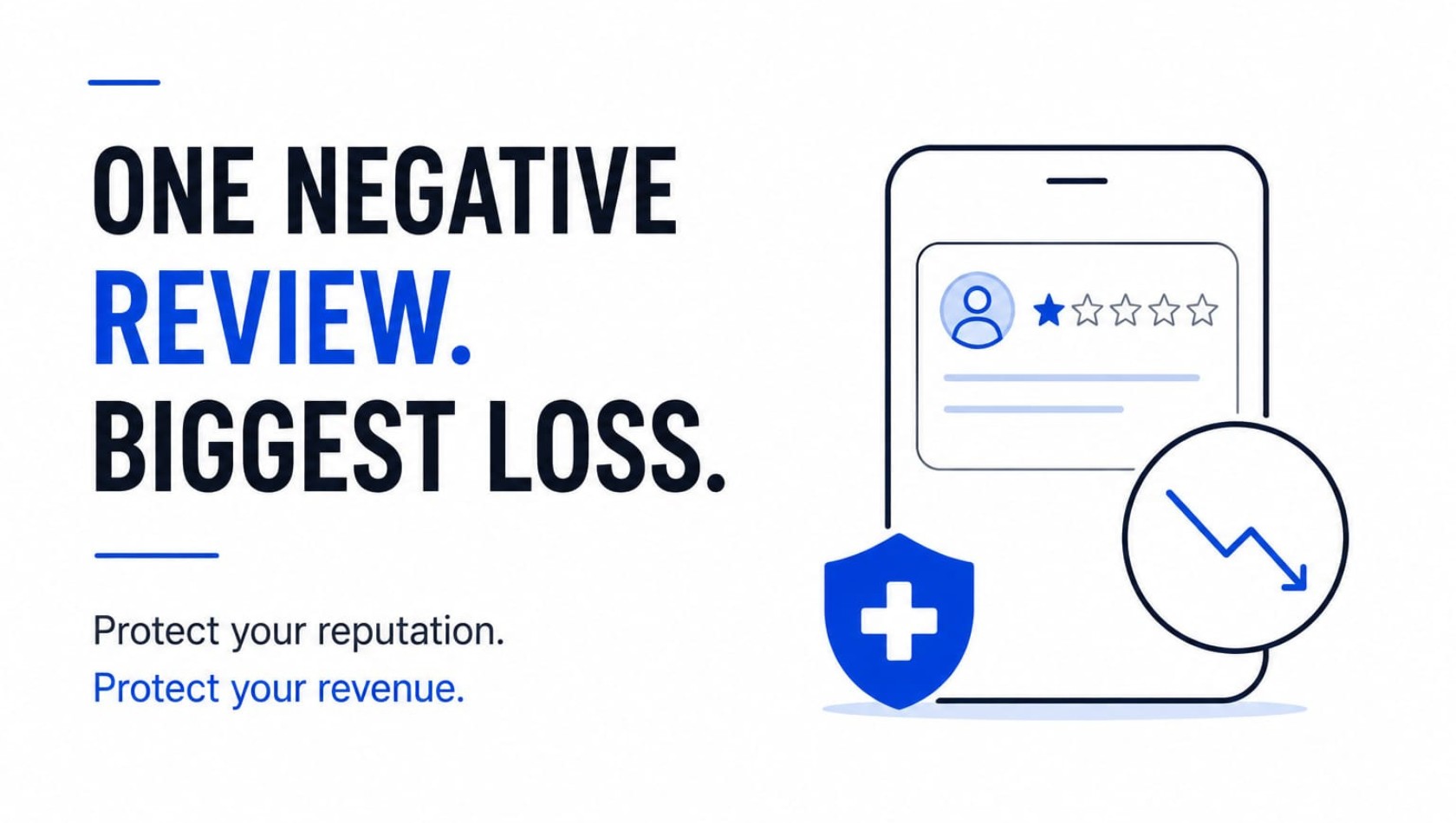
A patient with a $2,400 filler consultation on her mind opens her laptop, types a dermatologist's name into Google, and finds one unresolved one-star review on the first page. She closes the tab. She does not call the practice or explain why she changed her mind. She simply becomes a number nobody at the practice will ever see in a spreadsheet — a consultation that never happened, revenue that vanished before anyone on staff knew there was anything to lose.
This is what makes reputation damage so easy for cosmetic dermatology practices to underestimate: the cost isn't visible the way a cancelled appointment is. It shows up as a slow erosion in consultation volume that owners tend to blame on the season or the ad budget — anything but the review sitting uncontested on page one.
For most local businesses, this kind of erosion is a nuisance. For cosmetic dermatology, it is closer to a structural risk, because almost nothing about the way patients buy these procedures resembles a typical local-service purchase.
Why cosmetic dermatology is a uniquely review-dependent category
A missed call or a bad Yelp review costs a plumber a job worth a few hundred dollars, and the next search result down the page is close enough in price and quality that the customer barely notices the substitution. Cosmetic dermatology operates under fundamentally different dynamics. The purchase is elective, meaning there is no urgency forcing the patient to act despite hesitation. It is high-ticket, with individual procedures regularly running into four figures. And it is deeply personal — the outcome is visible on the patient's own face or body, which raises the psychological stakes of choosing wrong far above what governs, say, a restaurant booking.
That combination — elective, expensive, and personal — pushes patients into unusually heavy pre-visit research. They are not comparison-shopping on price alone; they are trying to answer a much harder question: can I trust this specific provider with my face? Reviews, before-and-after photographs, and platform ratings are the primary tools patients have to answer that question before they ever sit in a consultation chair.
This is precisely why category matters when practices try to estimate their own exposure. Research into review impact consistently finds that trust-dependent categories absorb more damage per negative review than low-stakes ones — healthcare, legal, and financial services face a disproportionate impact per individual negative review because the trust requirement and decision stakes in those categories are higher than in categories like restaurants or retail. Cosmetic dermatology sits at an even sharper edge of that pattern than general medical care, because unlike a routine physical, the patient is actively choosing between multiple providers rather than being assigned one by insurance.
This is the gap Nirjan International's work with aesthetic and dermatology practices is built around: treating online reputation not as a marketing add-on but as the primary mechanism by which elective, high-trust categories either win or lose a consultation before the phone ever rings.
Building the actual number: what reputation damage costs a practice
Most practices never calculate their reputation exposure because it feels abstract. It doesn't have to be. The math has three inputs: average procedure value, monthly consultation volume, and a review impact coefficient drawn from established research — and running it, even roughly, turns an abstract worry into a number a practice owner has to take seriously.
Start with the coefficient. Research from Harvard Business School has found that a single unaddressed negative review can cost a business up to 30 customers at the individual review level, while at the rating level, a one-star decline in average rating correlates with a 5 to 9 percent revenue reduction. Separately, research into how negative results affect search behavior has found that roughly three-quarters of prospective customers self-select out before ever clicking through to a business's website once a negative result is visible on the first page — meaning the damage happens upstream of anything a practice's own analytics can track. There is no missed call to log, no abandoned form to follow up on. The prospective patient never entered the funnel at all.
Put plainly, the model looks like this for a mid-size cosmetic dermatology practice — and this is illustrative, built on the research coefficients above, not a guaranteed outcome for any specific practice:
-
Average procedure value: roughly $700–$1,000 per patient once follow-up treatments are counted, comfortably inside RealSelf's own listed averages, where costs run from $209 for HydraFacial up to $1,031 for PRP injections and $1,747 for Sculptra.
-
Monthly consultation volume: a practice running 40 injectable and laser consultations a month is a realistic mid-size baseline.
-
Review impact coefficient: a 5–9% revenue decline per star lost, and up to 30 customers cut loose by a single unaddressed negative review, per the HBS research above.
Run those three inputs together and here's what emerges in real numbers: a practice running 40 consultations a month at an $850 average procedure value is sitting on roughly $34,000 in monthly consultation revenue. The rating-decline effect alone — a 5–9% revenue reduction per star lost — costs that practice $1,700 to $3,060 a month, or $20,400 to $36,720 a year. Separately, the HBS finding that a single unaddressed negative review can cut loose up to 30 customers translates, at the same $850 average, to another $25,500 tied to that one review specifically. These measure different things — one is rating-wide, one is review-specific — so they shouldn't be added into a single precise figure. But even taken conservatively and separately, a practice carrying more than one unaddressed negative review, or operating in a higher-ticket market, clears six figures in annual exposure without much difficulty. That is where a number like $150,000 in annual risk stops being a headline exaggeration and becomes a plausible outcome for a practice with a genuinely neglected reputation.
This is the calculation every cosmetic dermatology practice should be running with its own numbers, not treating reviews as a background nuisance to be dealt with whenever there's time.
RealSelf and the platform patients actually trust
General local-service businesses live or die on Google reviews. Cosmetic dermatology has a second, more specialized battlefield: RealSelf. RealSelf is a healthcare marketplace where consumers research aesthetic treatments and connect with physicians, with a website that has accumulated more than two million reviews, built specifically around plastic surgery, dermatology, and minimally invasive treatments. Patients researching a filler or a laser resurfacing treatment are not just checking Google stars — they are reading procedure-specific "Worth It" ratings, browsing real before-and-after galleries, and cross-referencing provider credentials in a way that simply doesn't happen when someone is choosing a plumber.
RealSelf's own verification system reinforces how central reputation is to visibility on the platform: only doctors with at least a 4-star patient rating can earn Verified status, and they have to maintain that rating to keep it. Reputation on RealSelf isn't just a trust signal patients read — it's a functional gate to being recommended prominently on the platform at all, and a slipping rating can quietly cost a practice the verified badge that made it discoverable in the first place. That's why a genuine RealSelf reputation strategy — not just a Google-first approach, checked quarterly rather than monitored continuously — is a business necessity for this category. Practices that track Google reviews closely but never look at their RealSelf standing are managing half the exposure and calling it reputation management.
The blind spot practices don't see coming: before-and-after photos as protected health information
Before-and-after photography is the single most persuasive marketing asset a cosmetic dermatology practice has — and it is also the piece of the reputation stack most practices are handling with the least legal rigor. Most owners treat photo consent as a formality bundled into a general treatment agreement. It isn't, and treating it that way creates exposure that has nothing to do with star ratings.
Photographs that show a patient's face, or other identifying features like tattoos or distinctive scarring, are typically treated as protected health information once they can be linked to that patient's identity. A generic treatment consent form does not authorize marketing use of those images — a separate, specific written authorization is required, one that names how the images will be used, where they will appear, and when that authorization expires. Crucially, patients retain the right to revoke that consent at any time, and once they do, the practice is obligated to begin removing the images from every platform where they appear — website, social media, print materials — without delay.
This matters in a very practical way: a practice's most valuable social proof is sitting in a legal gray zone if consent was captured casually, at the front desk, on a form nobody updated since the practice's early days. A revocation request that isn't handled quickly and correctly is not just an awkward conversation — it's a compliance failure that can surface publicly and do exactly the kind of reputational damage this article opened with, except self-inflicted. A signed form buried in a paper chart, unlinked to the specific images it authorizes, is functionally no better than no consent at all if a practice can't produce it quickly when asked what's being used and where. This is exactly the gap before after consent automation is built to close — a system where consent is captured digitally at intake, tied directly to the specific images it covers, and flagged automatically when it's due to expire or has been revoked.
Here is the uncomfortable part most practices don't want to hear: the asset generating the most consultations — the before-and-after gallery — is very often the least legally defensible thing on the website. A practice can have a five-star Google rating and a beautiful portfolio and still be one revocation request away from a compliance problem it has no fast way to resolve, simply because nobody ever built a system to track which photo belongs to which authorization.
From reactive damage control to defensive infrastructure
The practices that treat reputation as something to check occasionally are the ones running the arithmetic above without realizing it. The alternative isn't heavier-handed review begging — it's building reputation management into the operational spine of the practice, the same way scheduling or billing already are. In practice, aesthetic practice review generation and consent management work as a three-part operational loop rather than three separate tasks:
-
Capture at the moment of trust. Photo consent is collected digitally at intake, specific to marketing use and tied to an expiration date — not bundled into a general treatment form nobody reads closely.
-
Check in before the public does. A short private follow-up, sent a few days after the procedure once results are visible, asks the patient directly how they're feeling. A dissatisfied patient gets routed to a staff member for resolution; a satisfied one gets a direct, well-timed invitation to leave a review on the platform — Google or RealSelf — where the practice most needs the reinforcement.
-
Keep the record current. Consent and review status are tracked together, so a revoked photo authorization is pulled from every channel it was used on, and reputation across platforms is never being reviewed for the first time in months.
This is the layer Nirjan International's online reputation management systems for medical and aesthetic practices are built around: not reactive review monitoring, but structured infrastructure that generates reviews consistently at the right moment, keeps before-and-after consent documentation audit-ready across platforms, and routes dissatisfied patients to private resolution before they become public reviews. For a category where a single unaddressed one-star review can plausibly cost tens of thousands of dollars a year, that infrastructure isn't a marketing nice-to-have — it's the core of dermatology reputation management done properly, rather than as an afterthought.
Regional considerations
In the United States, average cosmetic dermatology procedures generally run from roughly $300 to $3,000 depending on the treatment, and RealSelf remains the dominant specialized research platform patients turn to before booking. Practices operating as HIPAA covered entities need photo authorization processes separate from general treatment consent, with documented expiration and revocation terms.
In Canada, similar dynamics apply in competitive urban markets like Toronto and Vancouver, with pricing typically quoted in CAD. Patient data handled through automated reputation and consent workflows falls under PIPEDA, which mirrors, but doesn't duplicate, HIPAA.
In Australia, competition is especially intense in Sydney and Melbourne, with pricing in AUD. The Privacy Act governs how patient images and health information can be captured, stored, and used in marketing.
In the UK, the NHS/private mix makes this category less directly comparable — the dynamics here apply most clearly to practices operating in the private cosmetic dermatology space specifically.
The underlying lesson holds across every market: in a category where the purchase decision is made almost entirely before the patient ever picks up the phone, reputation isn't part of the marketing plan. It is the marketing plan — and the practices that manage it deliberately, with real consent infrastructure behind it, are the ones that stop losing patients they never even knew they had.
Practices ready to move from checking reviews occasionally to managing reputation as core infrastructure can start with Nirjan International's Online Reputation Management service for Google, Meta, and Maps — built specifically to map existing exposure across platforms before recommending the system to fix it.
Comments (0)
Be the first to comment.