
The Hidden Patient Acquisition Cost: Why Medical Practices Are Overspending on Referrals and Underspending on Systems
By Team Nirjan
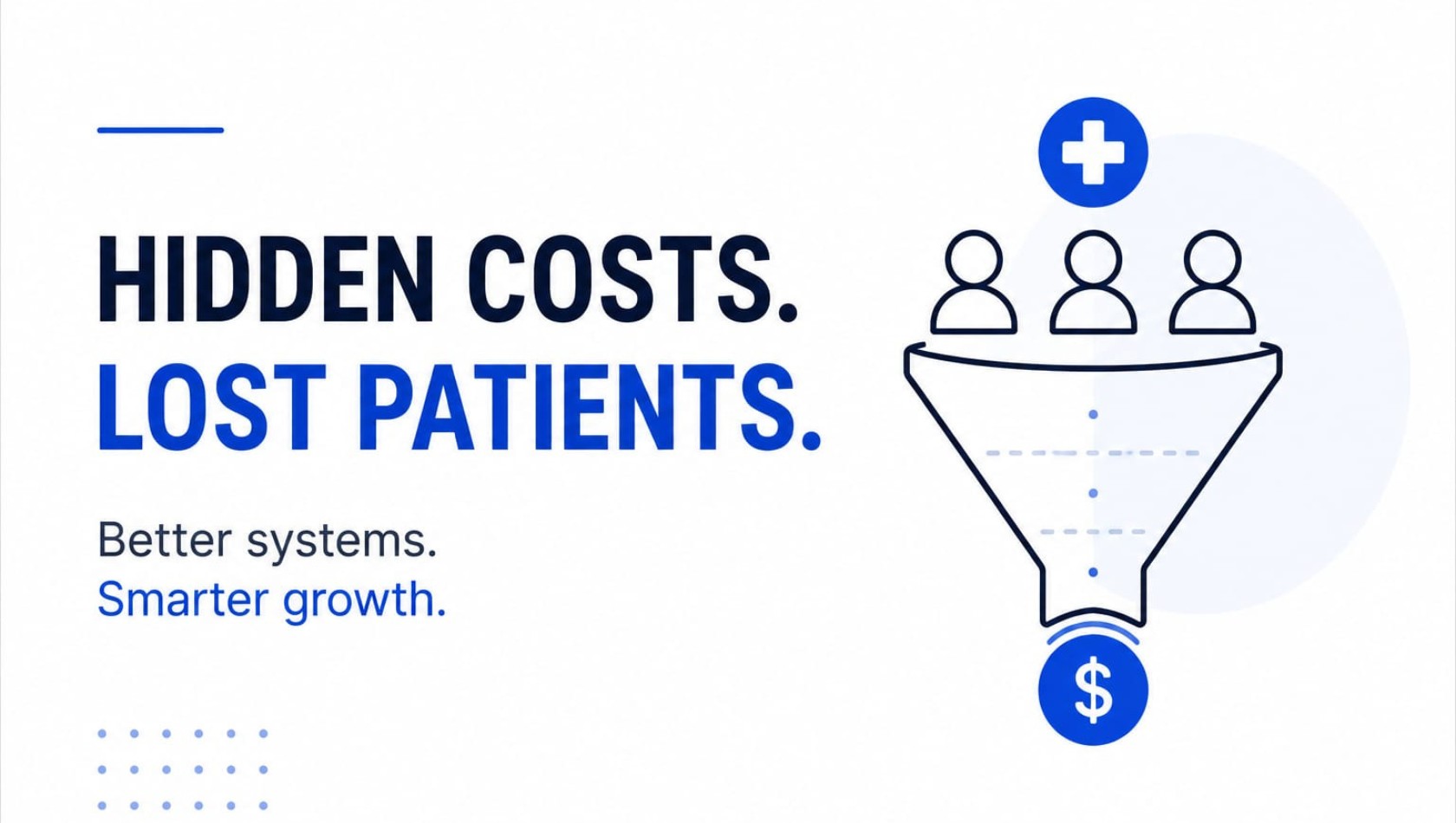
A dental practice spends $8,000 a month on marketing. At the end of the month, the practice manager reports the numbers the way most practices do: so many leads, so much cost-per-lead, a marketing dashboard that looks reasonably healthy. What that dashboard doesn't show is the patient who called, got a callback two days later, and booked with a competitor in the meantime. It doesn't show the patient who came in for a consultation, was quoted a treatment plan, and never scheduled the actual procedure. It doesn't show the patient who came once, felt fine, and never came back.
Cost-per-lead is the metric most practices track. Cost-per-acquisition-to-appointment is the metric that actually determines whether the practice is profitable. The gap between those two numbers is where most of a practice's marketing budget quietly disappears — and it's large enough that practices measuring only cost-per-lead typically understate their true acquisition cost by four to six times.
This isn't a marketing problem in the traditional sense. It's a systems problem wearing a marketing costume.
What "Patient Acquisition Cost" Actually Hides
Across specialties, patient acquisition cost in 2026 varies widely by procedure type and market. Dermatology practices typically pay somewhere between $150 and $600 per new patient, depending heavily on whether the visit is medical or cosmetic. Dental practices generally see $150 to $400. Chiropractic and other high-frequency, lower-ticket specialties often run leaner, in the $80 to $200 range. Across all specialties, the average lands somewhere near $370 per acquired patient, with the widest ranges appearing wherever competition is fiercest and the decision cycle is longest — cosmetic and elective procedures at the high end, urgent and high-frequency care at the low end.
Those numbers already look uncomfortable to most practice owners the first time they see them clearly. But the number itself isn't the real problem. The real problem is that most practices calculate it wrong — and calculate it in a way that flatters the marketing spend rather than exposing what's actually happening to it.
Here's the distinction that matters: cost-per-lead measures how much it costs to generate an inquiry. Cost-per-acquisition measures how much it costs to get a real, paying, kept appointment into the chair. Between those two points sits an entire funnel — contacted, scheduled, showed up, accepted treatment — and every one of those stages leaks patients. A practice that only tracks the first number is congratulating itself on a marketing campaign that may be losing money once the full picture is accounted for.
Mapping the Leak: From Lead to Chair
Picture the funnel as five distinct stages, because this is where a practice manager can actually see the money disappearing, rather than experiencing it as a vague sense that "marketing isn't working like it used to."
Inquiry. A person calls, fills out a form, or messages the practice after seeing an ad, a referral, or a search result. This is the number most dashboards proudly display.
Contacted. Someone from the practice actually reaches that person. This sounds trivial. It isn't. A significant share of inquiries never get a timely response — the call goes to voicemail, the form submission sits in an inbox until the next business day, the front desk is too busy with patients physically in the building to return calls promptly. Every hour of delay here is pure leakage, and it's the single most fixable stage in the entire funnel.
Scheduled. The contacted lead agrees to book an appointment. This is where a clunky booking process — phone tag, limited availability windows, no online option — quietly costs practices patients who had every intention of coming in.
Kept appointment. The scheduled patient actually shows up. No-show rates for dental and chiropractic practices commonly run in the 18 to 30 percent range without any automated reminder system in place — meaning a meaningful share of the marketing spend that got a patient this far still produces zero revenue.
Treatment accepted and retained. The patient shows up, and either accepts the recommended treatment plan and returns for follow-up care, or doesn't. This last stage is where the real revenue lives, and it's also the stage practices track least carefully. Two different numbers matter here, and they measure two different things: overall patient retention across a dental practice's full patient base sits at roughly 41 percent, while the figure that should actually worry a practice owner is narrower — only 5 to 20 percent of brand-new patients ever book a second appointment at all. The gap between those two numbers is retention infrastructure doing its job on existing patients while doing almost nothing for the new ones a practice just paid to acquire.
Look at that last figure again. If only one in five new patients returns, a practice is effectively paying full acquisition cost — $150, $300, $500 — for a large share of patients who generate a single visit and then vanish. No amount of front-end marketing optimization fixes that. It's not an acquisition problem. It's a retention system that doesn't exist.
Multiply this out and the scale of the leak becomes clearer. A practice acquiring 40 new patients a month at a blended $250 acquisition cost is spending $10,000 monthly to fill the top of the funnel. If a third of those patients no-show their first appointment, and only one in five of the ones who do show up ever comes back for a second visit, the practice's true cost per retained patient is several multiples higher than the $250 figure on the marketing report — even though nothing about the ad campaign itself changed. The leak isn't in the advertising. It's in everything that happens after the ad already worked.
The Cost of Inaction: Why the Existing Patient List Is Cheaper Than the Next Ad Campaign
Here is the number that should reframe how every practice owner thinks about their marketing budget: reactivating a lapsed patient costs a small fraction of acquiring a new one — commonly cited in the range of $12 versus $312 for a new dental patient, roughly a twenty-six-fold difference. Chiropractic practices see a similar pattern, where a structured outreach sequence to patients who haven't visited in 90 or more days typically recovers 8 to 12 percent of that dormant list, with no additional ad spend required at all.
Most practices don't act on this because the dormant list is invisible in a way that a Google Ads dashboard is not. Nobody reviews it monthly. Nobody assigns anyone to work it. It just sits in the practice management system as a growing pool of names that already trust the practice enough to have walked through the door once, receiving nothing more than perhaps an annual holiday postcard, while the practice keeps spending on Google Ads and social campaigns to find brand-new strangers instead.
The same pattern shows up in unaccepted treatment plans. A patient who received a diagnosis and a treatment recommendation but left without scheduling the procedure is not a cold lead — they're a warm one who already trusts the practice's clinical judgment. A structured, consistent follow-up sequence recovers a meaningful share of these cases, and treatment acceptance rates improve by 30 to 50 percent when that follow-up happens automatically and consistently rather than only when the front desk finds a spare ten minutes.
The uncomfortable truth underneath all of this: most practices are running hard on the front-end acquisition treadmill while a cheaper, faster source of revenue sits untouched in their own database. That's not a failure of marketing spend. It's a failure of systems.
Where the Leak Costs the Most, by Specialty
The size of this problem isn't uniform — it scales with how elective the procedure is and how the practice's physical capacity gets used.
Dermatology. Cosmetic and aesthetic dermatology sits at the high-competition end, with acquisition costs commonly running $150 to $600 per patient depending on whether the visit is medical or elective. Because procedures like injectables and laser treatments are fully private-pay and patients comparison-shop aggressively, response speed matters more here than almost anywhere else — a prospective patient evaluating a $2,000–$3,000 treatment package who doesn't hear back within minutes has usually moved on to a competitor's booking page before the practice even opens the next morning.
Dentistry. For dental practices, the bottleneck is less about response speed alone and more about chair-time utilization — a practice has a fixed number of operatories and hygienists, and every hour of chair time filled with a routine cleaning is an hour not available for a higher-margin implant or cosmetic case. An intake process that doesn't distinguish between a $150 cleaning inquiry and a $400-plus implant consultation risks misallocating the exact capacity that drives the practice's margin, regardless of how many total leads come in.
Chiropractic. The chiropractic funnel leaks differently than the other two. Initial acquisition cost is typically the lowest of the three specialties, in the $80 to $200 range, but the real revenue depends on patients completing a multi-week care plan rather than stopping after acute pain subsides. This is precisely why the 8 to 12 percent reactivation rate on lapsed 90-day patients matters so much here — a chiropractic practice's profitability depends less on constantly acquiring new patients and more on keeping existing care plans from quietly going dormant.
The Solution Framework: Three Systems, Not One Big Platform
The instinct when a practice manager hears "systems" is to imagine an expensive, complicated software rollout. That's not what actually closes this gap — the goal is three specific, narrow automations layered onto the scheduling and patient data a practice already has, not a platform migration. These three do almost all of the work.
Automated appointment reminders. This is the most well-proven of the three. Multi-channel reminders — text, email, and voice — sent at defined intervals before an appointment reduce no-show rates by roughly 20 to 38 percent across dental and chiropractic studies, without requiring front-desk staff to make a single manual reminder call. A confirmation immediately after booking, a reminder 48 hours out with a one-tap confirm-or-reschedule option, and a same-day reminder a couple of hours before the visit is a standard, effective sequence.
Automated reactivation sequences. For patients who haven't visited in 90 or more days, a structured, multi-wave outreach over several weeks — text and email, each with a direct booking link — brings a meaningful share of that dormant list back with zero incremental ad spend. The sequence should stop the moment the patient responds or books, so it reads as attentive rather than as an automated nag. For dental practices specifically, pairing this with simple intake qualification — routing implant and cosmetic inquiries differently than routine cleaning requests — helps protect chair-time for the cases that actually drive margin.
Automated treatment-plan follow-up. When a patient leaves without scheduling a recommended procedure, a timed follow-up sequence — not a single email, but a scheduled series over the following weeks — recovers cases that would otherwise represent pure sunk acquisition cost. This is where the revenue that was already paid for gets collected, rather than left on the table.
None of these three systems require a practice to become a technology company. They require the practice's existing patient management data to actually get used, rather than sitting untouched between visits.
The One Non-Negotiable: HIPAA-Safe Automation
This is where a lot of automation advice gets careless, and it's worth being precise about it, because a practice manager reading this will immediately ask the question if the writer doesn't answer it first.
None of these automations should ever carry clinical content. A reminder message says "Your appointment is tomorrow at 2:00 PM" — never "your root canal follow-up is tomorrow" or anything that names a diagnosis, a procedure, or a treatment. The automation reads appointment timestamps and visit-status flags, not clinical notes or billing codes. Handled this way, appointment reminders, reactivation outreach, and review requests contain no protected health information at all, which keeps the entire workflow outside the riskiest category of HIPAA exposure. Any practice implementing these systems should confirm the specific data-handling approach with whatever platform or partner is building it, and should have a signed business associate agreement in place before any patient data — even non-clinical scheduling data — flows through a third-party system.
Tactical Implementation: Where to Start
A practice doesn't need to build all three systems simultaneously. The order that produces the fastest, most measurable return:
-
Start with reminders. This is the lowest-risk, highest-certainty win — it protects revenue that's already been earned by reducing no-shows on appointments that are already booked.
-
Audit the dormant patient list next. Pull everyone who hasn't visited in 90-plus days and launch a simple reactivation sequence before spending another dollar on new-patient advertising. This is typically the fastest path to measurable new revenue, because it's recovering patients who already know and trust the practice.
-
Build treatment-plan follow-up last, once the first two systems are running cleanly, since it requires the most coordination with clinical staff to time correctly.
-
Track cost-per-kept-appointment, not just cost-per-lead, going forward. This single change in what gets measured is often what finally makes the size of the leak visible to the people who control the marketing budget.
Regional Realities
In the United States, patient acquisition costs and the competitive intensity behind them are highest, and HIPAA governs every automation decision without exception — any SMS, email, or scheduling system touching patient data needs a business associate agreement in place.
In Canada, acquisition costs run similarly in CAD terms, though the calculus shifts by specialty: many dental and chiropractic services are private-pay even where general healthcare is publicly funded, which means the acquisition-cost math for these specific practices looks much like its US counterpart, just under provincial privacy regulations rather than HIPAA specifically.
In Australia, Medicare doesn't cover most cosmetic dermatology or elective dental work, so acquisition cost dynamics for these practices mirror the US and Canadian pattern closely — private-pay, competitive, and heavily dependent on the same funnel leakage points described above.
Building the System
None of this requires a practice to hire a marketing team or adopt an enterprise health-system platform. It requires someone to actually connect the practice's existing scheduling data to a reminder sequence, a reactivation sequence, and a follow-up sequence — and to keep all three squarely on the safe side of HIPAA by carrying appointment logistics only, never clinical content.
This is precisely the gap Nirjan International's SMS, email, and lead-generation systems are built to close for dental, dermatology, and chiropractic practices. Rather than pushing a practice to spend more on the next ad campaign, Nirjan International builds the reminder, reactivation, and follow-up infrastructure that captures the revenue a practice has already paid to generate — the patients already in the funnel, not the next stranger who has to be found and convinced from scratch.
The practices that will grow fastest over the next few years won't necessarily be the ones spending the most on referrals and ads. They'll be the ones that finally started measuring cost-per-kept-appointment instead of cost-per-lead, and built the quiet, unglamorous systems that keep the patients they already paid for from quietly walking out the door.
If your practice is tracking leads but not tracking what happens to them between the phone call and the chair, the Nirjan International team that builds patient communication systems for dental, dermatology, and chiropractic practices can show you exactly where that gap is costing you — and what it takes to close it.
Comments (0)
Be the first to comment.