
The Chiropractic Patient Lifecycle: Why So Many New Patients Never Complete Their Care Plan — And How Automation Fixes It
By Team Nirjan
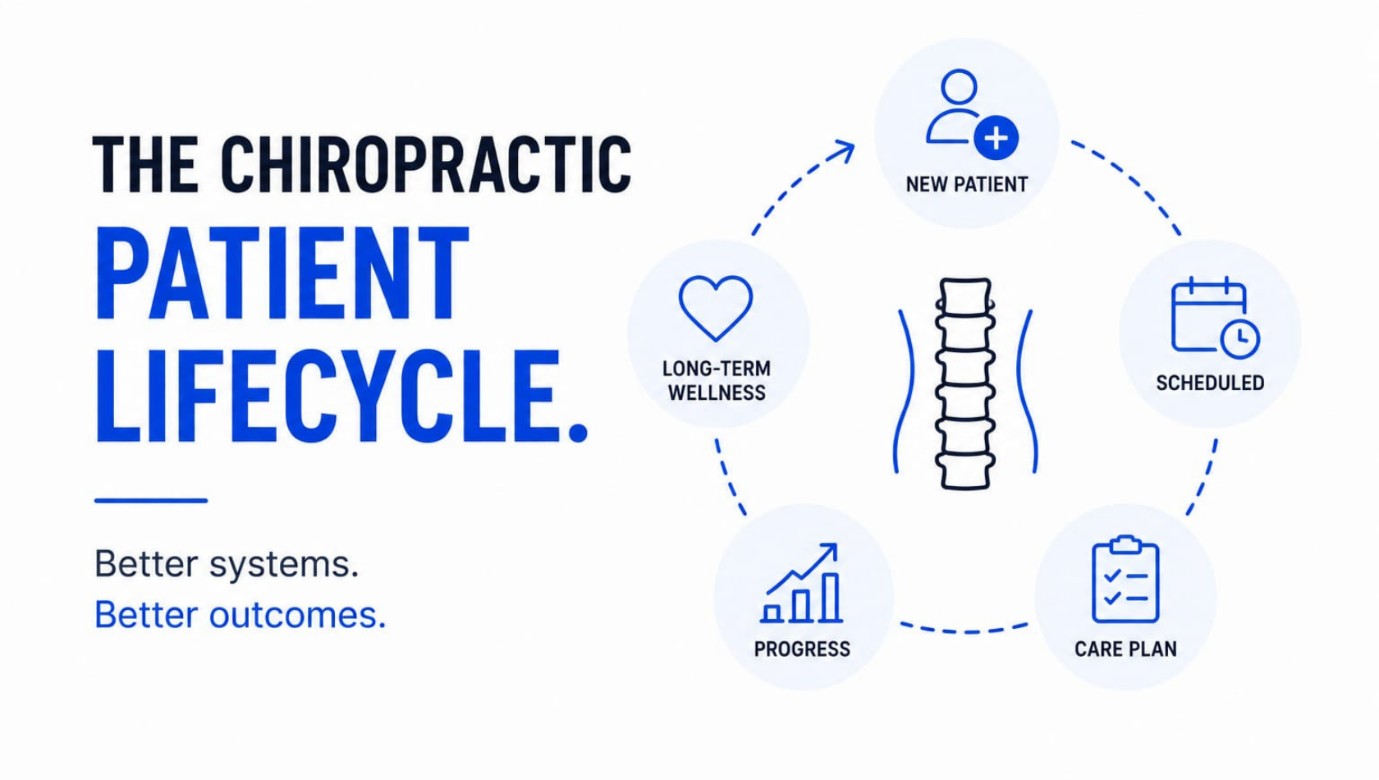
A new patient walks in with acute low back pain, sits through a thorough exam, agrees to a care plan, and leaves the first visit in less pain than they arrived with. Six weeks later, their file is inactive. No cancellation call, no complaint, no red flag in the schedule — just a patient who quietly stopped showing up.
This is the defining operational problem in chiropractic practice, and it is not caused by weak marketing or unconvinced patients. It is caused by a mismatch between how care plans are designed and how human behavior actually works between appointments. Understanding exactly where that mismatch occurs — and building automation around it — is the difference between a practice that grows and one that spends its entire marketing budget refilling a leaking funnel. Nirjan International works with chiropractic and wellness practices specifically on this gap: not by promising a magic retention number, but by mapping the exact points where a practice's own patients are falling off and automating a response to each one.
The Retention Numbers Are Messier Than They Look
Most retention conversations in chiropractic start with a single statistic and stop there. The real research doesn't support that kind of tidy number. Studies on adherence to chiropractic and physical rehabilitation care plans show enormous variability — clinic-visit attendance has been measured anywhere from 15% to 87% depending on the population and practice setting, and completion of prescribed at-home exercise ranges from 15% to 70%. One study found that only 43% of musculoskeletal patients completed a prescribed rehabilitation program through to formal discharge by their provider, and earlier research estimated that somewhere between 14% and 70% of patients self-discharge before their care plan is finished.
That spread matters editorially and operationally: any practice benchmarking itself against a single industry-wide "retention rate" is comparing itself to a number that doesn't really exist. What does hold up across the research is a more useful and more specific finding. A feasibility survey conducted at a US academic health center found that 89% of patients adhered to their scheduled clinic appointments, yet only 44% reported fully following through on at-home stretching and exercise recommendations — despite 82% saying the doctor's recommendation made clear sense to them.
That gap is the real story. Patients are not, in large numbers, rejecting the treatment or ghosting the practice out of skepticism. They are showing up, nodding along, and then quietly failing to do the unsupervised half of the work — the half no one is tracking. Retention, properly understood, is not one problem. It is two: getting patients back in the chair, and getting them to do what happens outside it. A practice can solve the first and still lose the patient to the second.
Where the Care Plan Actually Breaks
Across chiropractic operations research and practice-level reporting, patient drop-off tends to cluster around a small number of predictable moments rather than happening randomly throughout the plan:
Early relief mistaken for completion. This is the most consistently cited cause of both early and mid-plan dropout. A patient in acute pain who feels 60–70% better after three or four visits has no built-in reason to understand that the plan was designed around long-term correction, not short-term symptom suppression — unless someone explained that distinction clearly, visually, and more than once.
No durable understanding of the "why." Verbal-only care plan explanations at intake are easily forgotten. Patients who leave the first visit with only a spoken summary of an 8-, 12-, or 16-visit plan are working from memory by week three. Patients who leave with something they can see again — a written or visual plan tied to their specific complaint — have a persistent reference point that a verbal explanation can't provide.
Silent scheduling attrition. A missed appointment that isn't proactively rebooked within a short window rarely gets rebooked at all. The patient doesn't decide to quit; the gap simply widens until returning feels awkward or unnecessary. This is the single most fixable failure point in the entire lifecycle, because it isn't a clinical or motivational problem — it's a follow-up problem.
Invisible progress. Improvement that isn't measured and shown back to the patient doesn't feel like proof. A patient who can't see a documented trend — reduced pain scores, improved range of motion, functional milestones — has only their own inconsistent memory of how they felt three weeks ago to go on, which is a poor foundation for staying committed to visits ten through fifteen.
None of these four failure points requires a clinical fix. They require an operational one — which is precisely where automation earns its place in the conversation, rather than functioning as a generic add-on service.
What the Evidence Says About Automation — Including Its Limits
Appointment reminder systems have one of the more rigorously studied evidence bases in outpatient healthcare, and the results are strong enough to build a business case on. Automated SMS reminders alone have been shown to reduce no-show rates by roughly 38%, and multi-channel systems combining SMS, email, and voice reminders push that reduction into the 30–60% range across broader healthcare settings. For a chiropractic practice running a 12-visit care plan, that reduction compounds — every prevented no-show is one fewer silent gap that turns into a self-discharge.
It is worth being precise rather than promotional here: automated reminders are not universally superior to human contact. A comparative outpatient study found that automated telephone reminders were less effective at reducing no-shows than a live reminder call from clinic staff, and a 2026 study using predictive risk-flagging found that pairing automated reminders with a personal follow-up call for high-risk patients reduced no-shows from 36.2% to 32.8% — a meaningful but incremental gain, and one that only appeared when automation was combined with targeted human outreach, not left to run alone. The honest takeaway for a chiropractic practice is that automation should absorb the repetitive, high-volume communication load — reminders, confirmations, rebooking prompts — while flagging the patients who need a real phone call, rather than treating every patient identically.
On the care-plan side specifically, a 2025 study following more than 4,000 patients across multiple chiropractic and rehabilitation clinics found that patients who adopted a companion mobile app kept more of their prescribed therapy visits than those who didn't, and that among patients who eventually self-discharged, app users had completed 70% more of their prescribed visits before leaving than non-app users. That is a meaningfully different outcome from simply reminding someone about an appointment — it suggests that giving patients ongoing visibility into their own plan changes behavior even for those who ultimately don't finish.
This is the operational logic behind pairing Nirjan International's AI Appointment Booking System with GHL implementation rather than deploying a generic reminder tool: the system needs to do more than fire a text 24 hours out. It needs to trigger differently depending on where a patient sits in their care plan — a first-visit no-show requires a different message than a missed visit six weeks into an established plan, and a patient who has silently gone inactive for 30 days needs a different sequence again than one who is actively attending but skipping at-home exercises. A generic booking tool treats every gap in the calendar identically; a lifecycle-aware system treats a stalled care plan as a distinct event from an unfilled Tuesday slot, and responds accordingly.
Building the Automation Around the Actual Failure Points
Translating the four dropout causes into concrete triggers gives a practice something to implement rather than a philosophy to agree with:
-
At intake: a visual, plain-language care plan document — generated and sent automatically after the first visit — that answers what the plan involves, how long it runs, what it costs, and what "done" actually looks like clinically, rather than relying on the patient's memory of a five-minute verbal summary. The next visit is booked before the patient leaves the building, not left for them to call in later.
-
Reminder cadence: dual-touch reminders at 48 hours and 24 hours before each visit, which research on outpatient no-show reduction consistently shows outperforms a single reminder sent too close to the appointment to allow rescheduling.
-
The no-appointment-booked check: if a patient checks out without a future visit on the calendar, that alone is a signal worth acting on — a short automated nudge within 24 hours closes a gap that, left alone, tends to just keep widening.
-
Missed-visit recovery: an automatic rebooking prompt triggered within 24–48 hours of a no-show, before the gap has a chance to widen into disengagement — this is the highest-leverage intervention in the entire lifecycle because it acts on the most fixable failure point. A second, unanswered no-show should escalate to a staff call rather than another automated text; this is where a human catch matters more than another message.
-
Progress visibility: a simple patient-facing dashboard or periodic summary showing measured progress against the original plan, giving patients external proof of improvement rather than asking them to rely on memory.
-
Plan-completion handoff: at the final scheduled visit, an automated transition message and a pre-booked first maintenance appointment — the gap between "finished the plan" and "started maintenance" is where a lot of otherwise-successful patients quietly disappear.
-
Reactivation sequencing: a structured outreach sequence at 30, 60, and 90 days of inactivity, distinct from cold marketing, aimed at patients who dropped out of an active plan rather than prospects who never converted.
None of these five triggers is complicated in isolation. What makes them effective is that they run off a single, connected patient record rather than five disconnected tools — a text reminder platform that has no idea whether a patient is on visit two or visit eleven of its plan can only ever send generic reminders, not lifecycle-aware ones. Systems built through Nirjan International's automation and AI workflow integration can run each of these triggers off the same patient record, so a missed visit, a stalled care plan, and an inactive 90-day patient are treated as three different, appropriately-timed conversations rather than one generic marketing blast. The distinction matters more than it sounds: a patient who missed one visit needs a rebooking nudge, not a "we miss you, come back" campaign meant for someone who's been gone three months — sending the wrong message at the wrong stage reads as impersonal at best and as evidence the practice isn't paying attention at worst.
Regional Context
In the United States, where chiropractic visits typically run $40–80 and full care plans commonly fall between $1,500 and $3,000, the American Chiropractic Association (ACA) is the standard professional reference point, and the financial stakes of an incomplete plan are largely borne by the patient directly, since insurance coverage for chiropractic care is inconsistent. Any automated reminder or reactivation system handling patient health information also has to be built HIPAA-compliant from the start, not retrofitted later. Canadian practices operate on broadly similar pricing structures in CAD, with automated patient communication subject to federal PIPEDA requirements around consent and data handling. In Australia, chiropractic is a well-established profession with partial private insurance coverage, which somewhat softens the financial pressure on patients relative to the US and UK markets but does not change the underlying behavioral pattern of early-relief dropout; practices there need automation workflows that sit within the Privacy Act's handling requirements for health information. In the United Kingdom, chiropractors are regulated by the General Chiropractic Council (GCC), and because the NHS does not typically fund chiropractic treatment, nearly the entire patient relationship — and nearly the entire revenue consequence of a dropped care plan — sits with private practices, making retention automation a more directly bottom-line issue for UK clinics than in markets with partial insurance buffering. UK practices also need their messaging and CRM workflows built around GDPR consent requirements, which is a genuinely different technical starting point than the US market, not just a labeling difference.
The Part Most Practices Don't Want to Look At
There's an uncomfortable version of this problem worth naming directly: a chiropractor who sells a twelve-visit care plan in the consultation room is rarely the same person managing whether that patient actually shows up for visit nine. The clinical judgment and the operational follow-through are two different jobs, and most practices have built real expertise in the first while leaving the second to whichever front-desk staffer has a spare five minutes between check-ins. That's not a criticism of the staff — it's a structural gap. A practice that has never mapped its own attendance data past "we think people drop off around visit four or five" is, functionally, selling a course of care it has no system in place to actually deliver end to end. Fixing that isn't about convincing patients to want it more. It's about making sure the plan they already agreed to doesn't quietly depend on nobody forgetting to follow up.
The Real Cost of Getting This Wrong
A chiropractic practice that treats retention as a soft, relationship-driven outcome rather than a measurable operational system is absorbing a cost it has never actually quantified: every patient who silently drops out mid-plan represents lost revenue from the remaining visits, a lost opportunity for the kind of outcome that generates referrals, and — for practices offering maintenance or wellness membership tiers — a lost long-term relationship that never had the chance to convert.
The fix is not persuading patients to care more. It's building a system that catches the four predictable moments where commitment naturally wavers — first relief, faded understanding, a missed visit, invisible progress — and responds to each one automatically, consistently, and specifically, rather than hoping front-desk staff catch every gap manually amid a full schedule of adjustments and new-patient exams.
This is also why retention deserves the same deliberate attention as new-patient acquisition, rather than sitting downstream of it as an afterthought. A practice that spends heavily on ads and referral programs but has no system for catching a patient after their third missed visit is paying twice for the same problem — once to acquire the patient, and again, indirectly, every time that patient has to be re-acquired after quietly disappearing and eventually being remarketed to as a "new" lead. Practices that pair Nirjan International's GHL-based patient lifecycle automation with a clear, visual care plan presentation at intake are treating patient retention the way it actually behaves: not as one drop-off point, but as four separate, fixable ones — each with its own trigger, its own message, and its own measurable effect on how many patients actually finish the care plan they started.
Comments (0)
Be the first to comment.