
Dental Practice Growth Ceiling: When Chair Time Becomes the Bottleneck, Not Marketing
By Team Nirjan
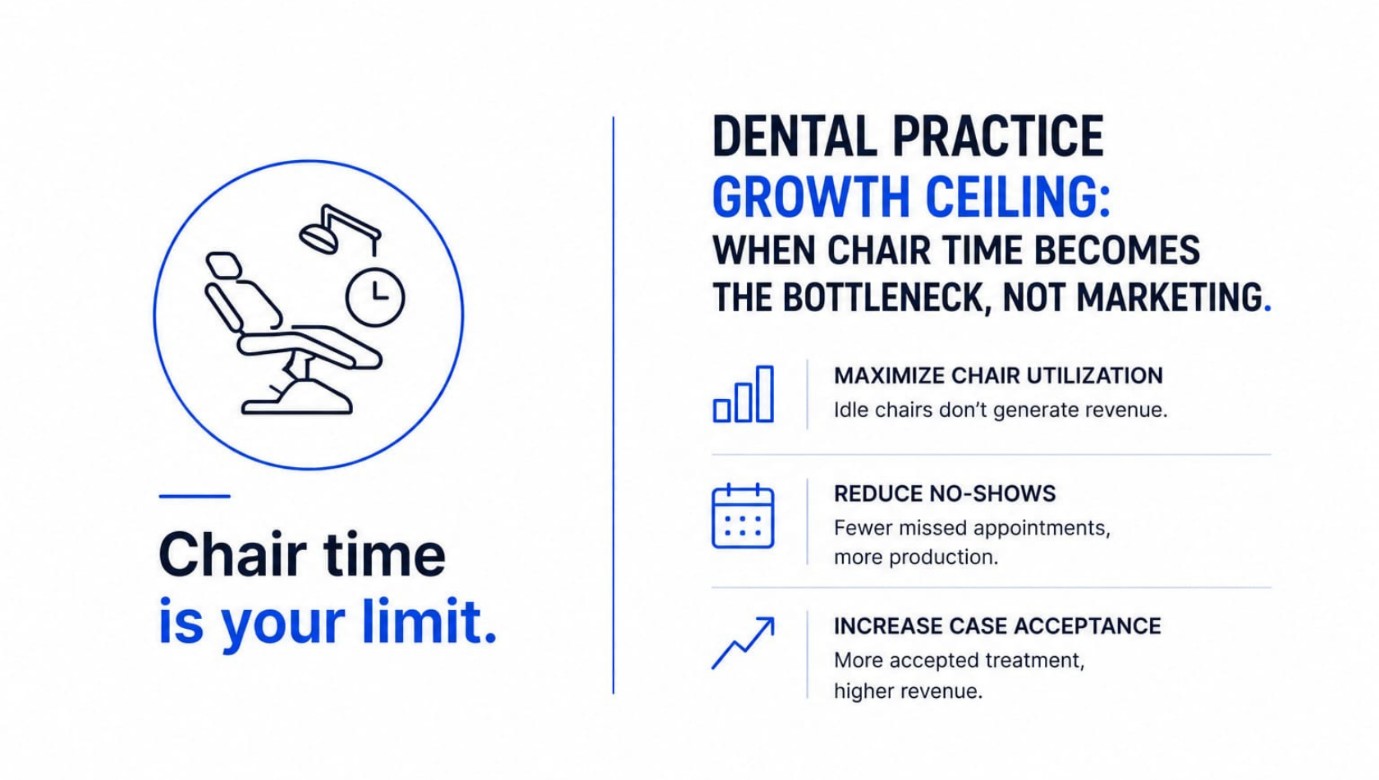
Somewhere between year three and year seven, a familiar pattern shows up in growing dental practices. Marketing spend climbs — local SEO, paid ads, referral programs. New patient inquiries increase. And then production flattens anyway. The phones ring, the schedule looks full weeks out, and revenue stays stuck within a narrow band no matter how much more gets spent to fill it.
The instinct is to treat this as a marketing failure and increase the budget further. That instinct is usually wrong. The constraint has quietly moved from demand to throughput — and no amount of additional lead flow fixes a practice that is already out of chair-hours to sell.
Theoretical Capacity vs. Actual Capacity
Chair utilization — the share of available chair-hours that generates production — is the metric that exposes this. The industry benchmark for healthy chair utilization runs 75% to 85%, with top-performing practices operating at 85–90%. Practice-management research frames anything below 80% as a sign that resources aren't being well used, and notes that capacity utilization, not the number of operatories or staff, is the primary measure of office efficiency — an eight-chair practice and a one-chair practice should both be running near capacity.
The financial gap between "busy" and "optimized" is larger than most owners assume. On a chair generating roughly $230,000 a year, moving from 75% to 85% utilization is worth approximately $30,000 in additional annual revenue — per chair. Across a four-chair practice, that's roughly $120,000 left on the table simply by running ten points below the achievable range. At the operatory level, production benchmarks put healthy general-dentistry output at $250–$600 per chair-hour; anything under $200/hour typically points to scheduling gaps or blocks that run longer than the procedure requires, and monthly production under $20,000 per operatory usually signals a scheduling, staffing, or case-acceptance problem — not a demand problem.
A simple model makes this concrete. Take a practice with four operatories and two hygienists, open eight hours a day. On paper, that's 32 chair-hours of daily capacity. In practice, that number was never real to begin with — it assumes every chair can be staffed simultaneously, which is exactly where most practices actually lose the capacity, long before a single patient cancels. In markets where dental care runs largely private-pay and labor costs are high — Australia is a clear example — that gap between theoretical and staffed capacity converts directly into lost margin, which makes closing it a cost-control question as much as a growth one.
Leak One: The Chair You Can't Staff
This is the leak marketing spend can't touch, and it's the largest one industry data currently points to. Only 60% of US dentists report having an adequate number of dental hygienists on staff, and among those actively recruiting, 91% call it very or extremely challenging. Heading into 2026, roughly 90% of practices report they are still struggling to hire, even with hygiene program enrollment at record highs — and staffing tied with insurance issues as dentists' top expected challenge for the year. The shortage isn't uniform — provincial licensing and scope-of-practice rules mean Canadian practices can face a materially different hiring picture from one province to the next, so the staffing math has to be checked locally rather than assumed from national figures.
Translated into the four-chair model above: a practice with two hygienists and one or two treating dentists can rarely staff all four chairs at once. The fourth chair isn't a scheduling gap — it's a hiring shortfall wearing a scheduling problem's clothes. This is the kind of leak a Nirjan International capacity assessment is built to surface before it gets misdiagnosed as a marketing problem. It's worth naming plainly, because it's the piece most practices skip past on the way to blaming their marketing.
Leak Two: The Hours That Get Booked, Then Vanish
Even fully staffed chairs leak time to no-shows and late cancellations. Over 81% of dentists say no-shows and cancellations actively keep their schedule from reaching full capacity, and the leading cause is mundane: 36% of missed appointments are simply forgotten, not refused or unaffordable. That makes this leak unusually solvable — it's a communication failure, not a demand or trust failure.
The channel matters. SMS reminders produce a 1.90% no-show rate, compared to 2.68% for email and 3.49% for phone calls, and automated reminder sequences cut no-shows by nearly 23% versus manual outreach. There's a booking-side version of the same gap: 82% of patients now prefer the convenience of mobile or online booking, yet only 26% of practices currently offer it— meaning most practices are still asking patients to call during business hours to fill a slot that a text link could close in seconds.
For UK practices, this leak sits on top of a more structural one: roughly 46% of NHS practices closed to new adult patients in 2025, with registration waits running 6–18 months in cities and stretching to 2–5 years in rural areas. That contract-capped quota makes every remaining private or mixed appointment slot more valuable — and makes recovering a cancelled private slot within minutes, rather than losing it to a same-day gap, a meaningfully bigger commercial loss than it would be in an uncapped market.
Leak Three: The Chair-Time That's Booked but Never Monetized
The final leak sits inside appointments that already happened. A 2026 industry benchmark puts average case acceptance at 45% of presented treatment plans, with top-performing practices reaching 75%. Acceptance measured by dollar value tends to run even lower than acceptance measured by procedure count, and general practices below roughly 65% typically show a systemic communication or follow-up gap rather than a patient-trust problem — healthy practices run 80–90%.
This means a fully-booked, fully-staffed, no-show-free chair can still underperform if half the diagnosed treatment in it never gets scheduled. The pattern tends to repeat in a specific way: a patient hears a recommendation, asks a reasonable question about cost or timing, says they'll think it over, and leaves. Nothing about that moment signals refusal — but without a structured follow-up sequence, that "I'll think about it" quietly becomes a permanent no, and the practice never finds out whether the real objection was price, timing, or simply not having the information restated once the initial appointment pressure was gone. The fix here isn't more chair time. It's closing the loop on treatment already diagnosed inside chair time that's already being used.
Closing the Leaks Without Adding Chairs or Staff
None of these three leaks get solved by hiring faster or building more operatories — both are slow, expensive, and in the case of hygienists, currently constrained by a labor market that isn't loosening in the US or easing consistently across Canada's provinces. The more available lever is automating the processes sitting on top of the capacity that already exists:
Scheduling that accounts for real staffing constraints. Rather than booking chronologically, automated scheduling logic can flag high no-show-risk slots for reinforced confirmation, hold flexible buffer capacity for genuine emergencies, and route waitlisted patients into cancellations automatically rather than through a manual call tree.
Patient communication that closes the no-show gap. Multi-touch, SMS-first confirmation sequences directly target the mechanism behind the 36% of no-shows caused by forgetting — and give the 82% of patients who prefer mobile booking a way to actually use it. In quota-constrained markets like the UK, this same infrastructure is what lets a practice recover a cancelled slot in minutes rather than losing it outright.
Treatment plan automation that recovers diagnosed revenue. Sending patients a clear, mobile-friendly breakdown of a diagnosed treatment plan — cost, financing, insurance estimate — while the recommendation is still fresh, and following up systematically rather than once, is what moves a practice from the 45% average acceptance rate toward the 75% top-performer range.
This is the layer Nirjan International's Automation & AI Workflow Integration service is built around: connecting scheduling, patient communication, and treatment-plan follow-up into a single system rather than three disconnected tools competing for the front desk's attention.
The Real Growth Lever
A practice that has hit its growth ceiling doesn't need a bigger funnel. It needs to know exactly where its existing chair-hours are leaking — to staffing gaps, to forgotten appointments, to treatment plans nobody followed up on — and to close those gaps before spending another dollar acquiring a patient it may not have the capacity to properly treat.
For practices evaluating where to start, a dental practice capacity audit built around these three leaks is a more useful next step than a bigger ad budget — and it's where Nirjan International's automation work typically begins.
Comments (0)
Be the first to comment.