
The RTO Compliance Trap: Why Marketing Automation Is Considered "Too Risky" — And Why That's Backwards
By Team Nirjan
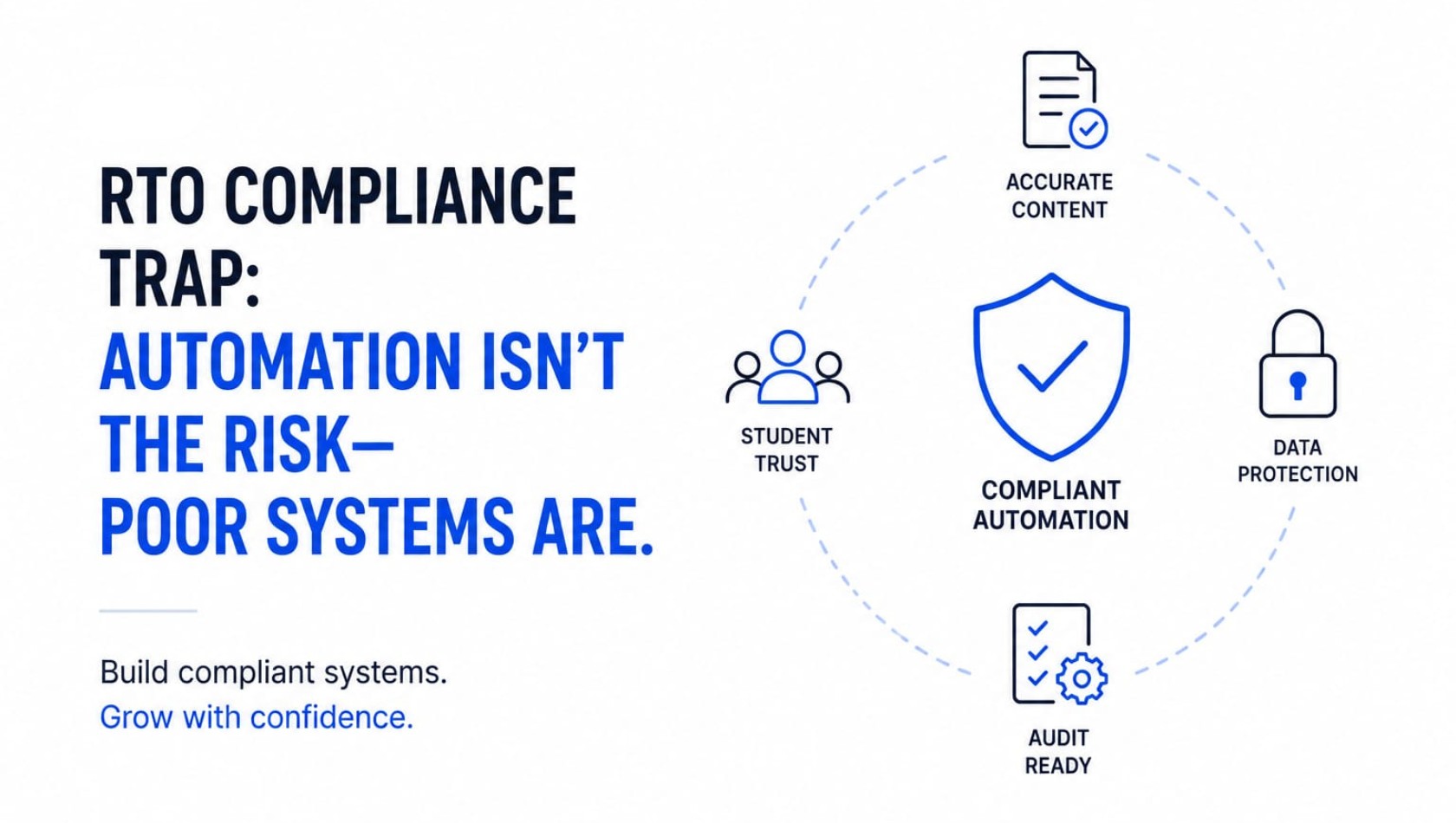
For most registered training organisations in Australia, marketing automation sits in the same mental category as a shortcut through a compliance minefield. Ask a training manager why their enrolment marketing is still built on manual email sends, one-off social posts, and a shared drive full of course copy nobody remembers approving, and the answer is rarely "we haven't thought about it." It's "we don't want to risk it."
That instinct is understandable. It is also, in most cases, exactly backwards. Getting RTO marketing automation right in Australia isn't a generic software purchase — it's a compliance design problem first and a technology choice second.
Under the current Standards for RTOs 2025, which took full regulatory effect on 1 July 2025, the Australian Skills Quality Authority has moved decisively away from checking whether policies exist on paper and toward demanding evidence that systems actually operate the way an RTO claims they do. That shift changes the compliance calculation entirely. A manual, undocumented marketing process — the kind most RTOs assume is "safer" — often has no audit trail at all. A properly built automated system, by contrast, produces one by default. The organisation that fears automation the most is frequently the one with the weakest evidence file already sitting in a drawer.
This piece breaks down where the fear comes from, why it is misdirected, and what a compliance-literate approach to marketing automation actually looks like for an RTO operating under ASQA's current risk-based audit model — the kind of system Nirjan International builds for training organisations that want the efficiency of automation without gambling on their registration.
Where the Fear Comes From — And Why It's Not Irrational
RTO operators aren't wrong to treat marketing as a compliance-sensitive function. It is one of the areas ASQA scrutinises most closely, and for good reason.
Marketing obligations sit under Standard 4 (Information and Transparency), and specifically Clause 4.1, which requires that any advertising or marketing material — website copy, brochures, course landing pages, social media posts, third-party promotional content — be accurate, current, accessible, and not misleading. Every piece must display the RTO's registration code or a link to the relevant part of the National Register. Claims about guaranteed job outcomes, government funding eligibility, or accreditation pathways are treated with particular scrutiny; overstating any of them is one of the more common triggers for regulatory attention.
Some of that caution has real history behind it, not just anecdote. The 2015–2017 VET FEE-HELP crisis, in which aggressive and sometimes misleading recruitment practices at a number of private providers triggered a sector-wide regulatory crackdown, is still the reference point for why Australian RTOs treat marketing scrutiny as existential rather than administrative. That history is legitimate. It is also, increasingly, being applied to the wrong target. The practices that caused the VET FEE-HELP collapse were about what was being claimed to students — guaranteed outcomes, misrepresented funding, high-pressure sales tactics — not about whether the claims were delivered by a person or a system. Automation wasn't the mechanism of that failure. Unchecked, unaccountable claims were.
This is where the automation hesitation comes from today. RTO owners have watched competitors get burned — a course description that oversold an outcome, a funding claim that wasn't quite current, a social post that a franchisee or marketing contractor pushed out without sign-off. The logical (if flawed) conclusion is: the more hands and systems touching marketing content, the more chances something slips through unreviewed. Automation, in that framing, looks like it multiplies the risk surface rather than shrinking it.
There's also a quieter dynamic at play. The compliance advisory sector around Australian RTOs has grown large enough that some of it now trades in urgency as a sales tactic — framing every technology decision, automation included, as a step that could invite regulatory attention unless a consultant is engaged first. Some of that caution is warranted. Some of it is simply fear repackaged as a service line, timed to regulatory deadlines that are already public and unremarkable once you read the actual instrument. It's worth separating the two: healthy scepticism about a specific vendor's data-handling practices is reasonable; treating automation itself as inherently more dangerous than the manual process it would replace is not, and it's rarely examined closely enough before RTOs default to "safer to do it by hand."
What that framing misses is what actually causes marketing breaches. It is almost never the existence of a system. It is the absence of one — no version control on course copy, no record of who approved a claim before it went live, no consistency check across the ten different places a course description appears. A marketing team copying and pasting from memory into five different channels is not more compliant than an automated workflow drawing from a single, pre-approved source. It is simply less visible when it goes wrong — until an audit asks for evidence, at which point the absence of a paper trail becomes the finding, not the marketing claim itself.
What Manual Marketing Actually Costs You Under a Risk-Based Audit Model
ASQA's current approach is explicitly risk-based: not every RTO is audited the same way, and audit attention is increasingly directed at providers whose data, complaint history, or scope of registration flags elevated risk. But when an audit does happen under the 2025 Standards, the expectation has shifted from "show me the policy" to "show me the evidence that the policy is actually followed."
This is precisely where manual marketing processes fall apart. Consider what a typical unaudited process looks like at a mid-sized RTO:
-
A course description is drafted once, possibly years ago, and copied across the website, a brochure PDF, and several social captions — with no record of when it was last checked against current fees, funding eligibility, or delivery mode.
-
Marketing staff or a contracted agency post content independently, with no centralised approval step and no log of who signed off on specific claims.
-
The registration code or National Register link is present on the main website but inconsistently applied across social media, paid ads, or third-party listing sites.
-
When a claim is questioned, there is no timestamped record of who wrote it, who approved it, or what version was live on a given date.
None of this looks alarming day-to-day. It becomes alarming the moment an auditor asks for evidence of a governance process — because there isn't one to show. The absence of a system, in other words, is not a lower-risk position. It is simply a risk that hasn't been tested yet.
There's a second, less discussed cost: staff time. Every one of those manual checks — confirming a fee is current, tracing who approved a claim, cross-referencing a social post against the website — has to happen somewhere, by someone, usually under time pressure right before a campaign goes out. RTOs that treat marketing compliance as a manual review step typically absorb that cost as ongoing administrative drag rather than recognising it as a system failure. It shows up as a compliance manager quietly re-checking old brochures on a weekend, not as a line item anyone budgets for. Automated compliance-by-design doesn't eliminate that oversight function — it relocates it, from a repeated manual check performed under pressure to a one-time system configuration that then runs consistently in the background.
The Compliance-by-Design Framework
The alternative isn't "add more marketing tools." It's building what might be called an audit-ready marketing stack — automation architected from the outset around three principles: locked content, traceable approval, and consistent output.
Locked Copy Banks, Not Ad-Hoc Drafting
Every claim an RTO makes publicly — about fees, funding eligibility, course duration, delivery mode, or outcomes — should live in one pre-approved, version-controlled source. Automated systems can then pull from that source across every channel: website, email, SMS, social scheduling, third-party listings. Nobody drafts a fresh claim from memory at 4pm on a Friday. They select from what's already been checked.
Approval Workflows With a Timestamp
Automation doesn't remove human judgement from marketing sign-off — it makes that judgement visible and provable. A workflow where new or updated course copy routes automatically to a compliance-responsible person before it can publish, with a recorded approval and date, is the exact evidence an auditor is now looking for under the outcome-focused 2025 framework. Manual processes rarely produce this record voluntarily. Automated ones can be built so that publishing without it simply isn't possible.
Registration Code and National Register Consistency
A rules-based automation layer can enforce that the RTO's registration code, or a working link to the National Register, is injected automatically into every outbound marketing asset — website page, brochure template, social post, paid ad — rather than relying on someone remembering to add it each time. This single fix closes one of the more common, and easily avoidable, compliance gaps ASQA identifies during marketing reviews.
Audit Logging by Default
Perhaps the most underused benefit: a properly configured CRM or marketing workflow keeps a running, timestamped log of what was published, when, by whom, and under what approval. When a performance assessment happens — sometimes with only one to three months' notice, sometimes with less — that log is the difference between producing evidence in minutes and reconstructing a marketing history from memory and old email threads.
Setting the Boundary: What Belongs to the System, What Belongs to a Person
Not every part of the student journey is a candidate for automation, and pretending otherwise is how compliance-by-design turns into compliance-by-negligence. The useful distinction isn't "can a machine do this" — it's whether automating a given step improves or degrades the accuracy and accountability ASQA is actually assessing.
Some functions are safe to automate with minimal oversight because they involve verification against a fixed, external data source rather than judgement calls: confirming a Unique Student Identifier (USI) is valid at the point of enrolment, or validating that enrolment data meets AVETMISS reporting requirements before it's submitted through NCVER's reporting pathway. These are binary checks — the data is either correct against the register or it isn't — and a system performs them more reliably and more consistently than a person doing it manually at volume.
Other functions need automation plus a human checkpoint: course recommendations generated from a prospective student's stated goals are useful as a starting point, but a qualified staff member should confirm suitability before enrolment proceeds; standardised information about funding eligibility can be distributed automatically, but anything resembling individualised financial advice needs a person attached to it.
And some things should never be automated at all: any claim about guaranteed employment outcomes, complaint handling and resolution, or anything touching a student's individual circumstances that requires judgement rather than a lookup. Automation earns its place by handling the verification work reliably — it doesn't replace the human accountability the Standards are actually built around.
This is roughly where Nirjan International starts when building an ASQA-compliant CRM for a training organisation: mapping which touchpoints are pure verification work and which need a person in the loop, before a single workflow gets switched on. RTOs that skip this mapping and automate everything at once tend to underestimate how much staff time is currently going into exactly the checks a system could handle — anecdotally, training managers running largely manual enquiry-to-enrolment processes often describe losing the better part of a working day each week to compliance cross-checks that a locked, rules-based workflow performs in the background without anyone noticing.
Where to Start: Four Automatable Touchpoints
RTOs don't need to overhaul every system simultaneously. The highest-value starting points are usually:
-
Website course pages — centralise all course claims in one approved source that populates every page, rather than maintaining separate, independently edited copies.
-
Social media scheduling — restrict scheduled content to a pre-approved template bank, so nothing publishes without having passed through the locked copy layer first.
-
SMS and email nurture sequences — build enrolment follow-up sequences from approved templates only, with no free-text claims inserted ad hoc by staff mid-conversation.
-
CRM field validation — configure enrolment and enquiry systems so that fields referencing funding eligibility, outcomes, or accreditation pull from verified data rather than allowing free-text entry that can drift from what's currently accurate.
None of these require enterprise-level budgets. They require deliberate system design — which is a different problem from the one most RTOs are actually afraid of.
The sequencing matters more than the scale. Trying to automate everything simultaneously — website, socials, nurture sequences, and CRM fields all at once — is how compliance gaps actually get introduced, because nobody has time to properly test each layer before the next one goes live. A more defensible rollout starts with the locked copy bank alone: get every course claim into one approved source before automating a single channel that draws from it. Only once that source is verified and stable does it make sense to connect website pages, then social scheduling, then nurture sequences, each tested against the approved source before the next is switched on. An RTO that can show an auditor a staged implementation record — what was automated, when, and how it was verified — is demonstrating exactly the kind of continuous improvement practice the current Standards are designed to reward.
The Real Trade-Off
None of this is an argument that automation is risk-free. A badly configured system — one where templates go stale, where approval steps are skipped for the sake of speed, or where nobody owns the review cycle — can be just as exposed as a manual process, arguably more so if the false sense of security stops anyone from checking it. An automated system that nobody maintains is not a safeguard; it is a manual failure with better production values. The point isn't that automation is automatically safer. It's that automation built with compliance as a design requirement, not an afterthought, produces exactly the kind of evidence the current Standards ask for — and that a manual process rarely produces that evidence at all, regardless of how careful the people running it try to be.
This distinction is also why the "automation versus compliance" framing was always the wrong question. The real question is who owns the system once it's built. A locked copy bank still needs someone responsible for reviewing and re-approving it on a schedule. An approval workflow still needs someone who actually reads what they're signing off on, rather than clicking through a notification. Automation doesn't remove the governance function an RTO already needs — it just gives that function something concrete to point to when asked to prove it exists.
This is the operational work Nirjan International does for RTOs navigating the 2025 Standards: building an ASQA-compliant CRM where compliance isn't a separate checklist bolted on after the fact, but the underlying architecture the automation runs on. It isn't about replacing judgement with software — it's about making sure the judgement that already happens leaves proper RTO audit documentation behind it.
For RTOs still treating automation as the risk rather than the safeguard, the more useful question isn't whether to automate. It's whether the current manual process — or the RTO student management system it currently leans on — could actually survive a performance assessment tomorrow, and what it would take to prove it, if asked.
If your RTO is weighing how to modernise Australian vocational education automation without compromising audit readiness, the Nirjan International team that handles Systems and CRM Building for Data Management designs automation with the approval trail, version control, and registration-code consistency Australian RTOs need to operate confidently under the 2025 Standards. Explore how a compliance-first CRM and marketing workflow for RTO and Government-Regulated Industries could work for your organisation's specific scope and risk profile.
Nirjan International builds operational systems for regulated Australian industries. Its approach to RTO marketing automation in Australia is built around ASQA compliance from the outset — because in vocational education, an RTO's registration is its business.
Comments (0)
Be the first to comment.