
The Confidentiality Paradox: Why Business Brokers Can't Market Listings Effectively — And How to Fix It
By Team Nirjan
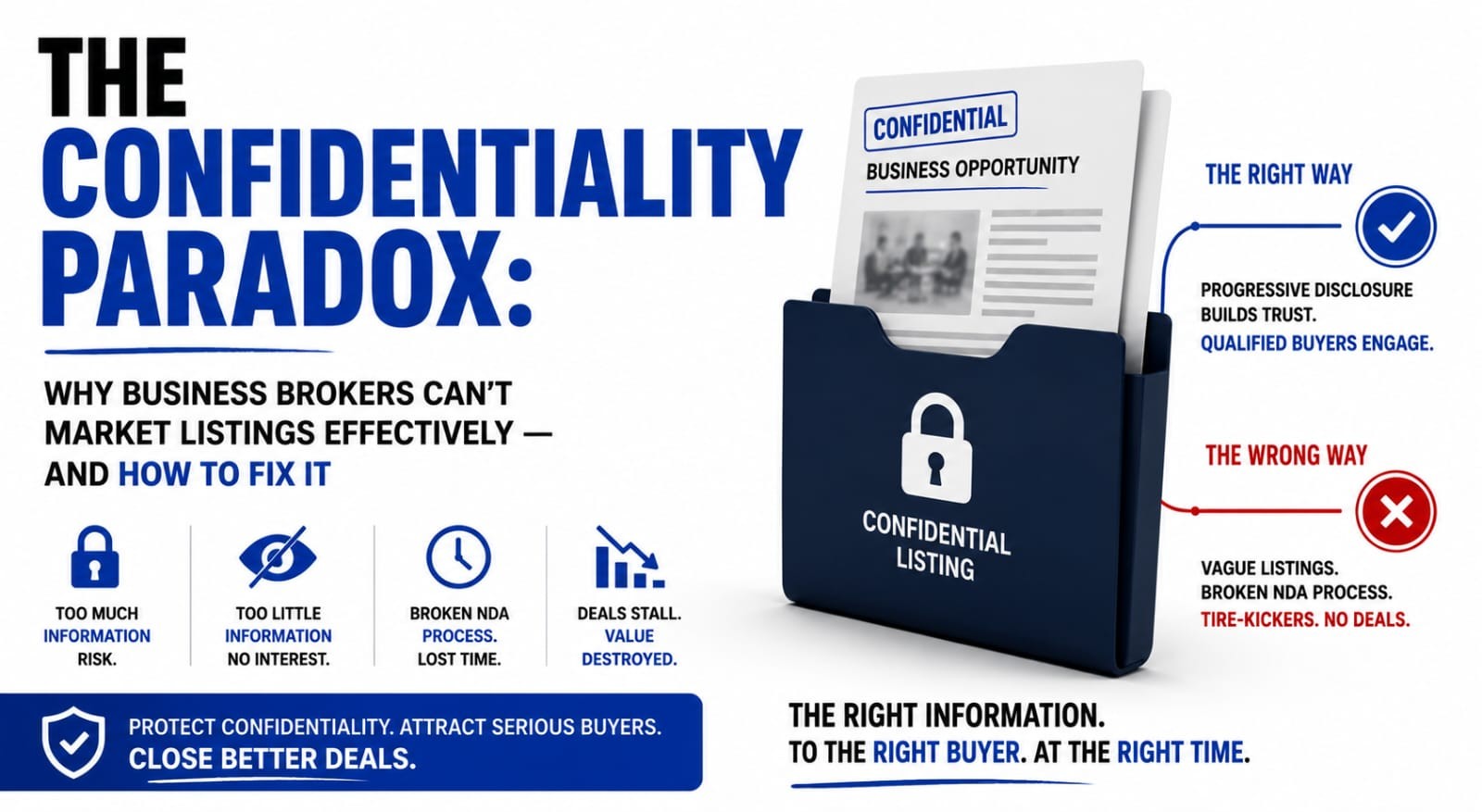
Every business broker eventually faces a version of the same impossible instruction: market this business as widely as possible, but make sure nobody figures out what it is.
That is not a niche frustration. It is the defining structural tension of the entire profession — and it sits at the center of why so many confidential business listings stall, why qualified buyers disengage early, and why brokers spend disproportionate time on deals that never close.
A house can be photographed, geo-tagged, listed on a public MLS, and shown to anyone with an appointment. Nothing about that process threatens the asset. A business is different. A business is a living system of relationships — with employees who have options, customers who have alternatives, suppliers who reassess credit terms the moment they sense instability, and competitors who will exploit any signal of a distressed or departing owner.
When a business goes to market openly, the damage begins before the ink dries on the listing agreement. Key employees start fielding calls from recruiters. A major customer, having caught wind of a potential ownership change, quietly begins evaluating other vendors. A supplier tightens payment terms. The business that was worth $1.8 million at listing begins to look like $1.4 million six months later — not because the fundamentals changed, but because confidentiality failed.
This is the Confidentiality Paradox: the mechanism of selling a business is capable of destroying it.
Why the Blind Profile Stopped Working
The industry's traditional answer to this paradox is the blind profile: a one-page teaser that describes a business in enough generalized terms to invite interest without revealing identity. A profitable HVAC company in the Southeast. Revenue $2.4M, owner-operated, established client base, owner retiring.
This approach made sense when the buyer pool was local, when deals were found through professional networks, and when buyer expectations were shaped by a handshake culture. None of those conditions apply in 2026.
Today, a serious buyer shopping in the $500K–$5M range — the segment the IBBA (International Business Brokers Association) describes as "lower middle market" — has access to BizBuySell, Acquire.com, multiple broker databases, and LinkedIn outreach from competing advisors. They are evaluating fifteen listings at once. A vague blind profile in that context does not create intrigue. It creates friction.
Buyers scroll past it or, worse, submit an NDA request that sits in someone's inbox for four days before receiving a PDF attachment. The result is a lead quality problem that compounds on itself. Vague listings attract volume — tire-kickers, curiosity seekers, unqualified enquirers — while the genuinely qualified buyer, the one with liquidity and industry knowledge and a credible acquisition thesis, moves on to a better-presented opportunity.
The broker ends up fielding fifty NDA requests to find three real conversations. The listing ages. The seller grows anxious. Price expectations shift downward.
In the UK, where business transfer agents operate in tighter geographic markets — a business being sold in a mid-sized city like Leeds or Bristol is considerably easier to identify from vague descriptors than one in a broad US metro area — the problem is even more acute. Anonymization that works in Houston is insufficient in Harrogate.
In Australia, where brokers list on platforms like Bsale alongside general business-for-sale databases, the same dynamic applies: buyers expect structured disclosure, not cryptic teasers. In Canada, the Canadian Business Brokers Association (CABB) has increasingly emphasized professional standards around information handling — yet the typical brokerage workflow remains closer to 2010 than 2026.
The NDA Process Is Broken, and Most Brokers Know It
Before a qualified buyer receives a Confidential Information Memorandum (CIM), they are supposed to sign a Non-Disclosure Agreement. This is the legal checkpoint that separates public marketing from confidential disclosure. In theory, it creates an enforceable paper trail. In practice, most brokers run their NDA automation with tools that would embarrass a mid-sized law firm.
The typical workflow looks like this: a buyer expresses interest; the broker emails a Word document NDA; the buyer downloads it, signs it, scans it, and returns it — or forgets, and the broker follows up manually three days later. There is no timestamp on when the document was sent. There is no automated record of which buyer signed which NDA for which listing. There is no systematic escalation if the NDA is not returned. And there is certainly no integration between the signed NDA and the system that controls access to confidential materials.
This is not a minor administrative gap. It is a legal and operational liability. A broker who cannot produce a timestamped, verified record of NDA execution before confidential disclosure has almost no legal recourse if that buyer uses proprietary information to poach customers, approach key employees, or undercut the seller's position in the market.
Beyond the legal exposure, the manual NDA process signals something to buyers that brokers rarely consider: it communicates that this broker operates at a consumer grade. Serious acquirers — private equity-backed search funds, strategic buyers, experienced owner-operators — make rapid judgments about the quality of a deal based on how it is presented. A Word document NDA emailed from a personal Gmail account does not inspire confidence in the deal itself.
The Cost of the Current Approach
The financial impact of this paradox is rarely calculated, but it is severe. Consider the operational math:
Lost Commission Revenue. Average business brokerage commissions — typically 10% to 12% of sale price according to IBBA transaction benchmarks — mean that mid-market listings priced between $800,000 and $3 million represent $80,000 to $360,000 in commission per deal. If confidentiality concerns or marketing friction cause even a modest portion of listings to expire without a buyer, the aggregate revenue loss across a multi-broker firm runs into the hundreds of thousands annually.
The Hidden Labor Tax. Manual confidentiality and vetting processes consume extraordinary time. Initial buyer screening requires several hours per prospect. The NDA cycle — draft, send, follow up, collect, file — consumes additional hours. Document management, tracking, and controlled disclosure add further hours per active deal. For a broker managing multiple listings with several qualified buyers each, this administrative burden totals hundreds of hours annually — time not spent closing deals, but managing the friction that the current system creates.
Buyer Abandonment. Industry observation suggests that manual NDA and qualification processes create a multi-day delay between initial buyer interest and access to substantive information. During that window, a significant portion of interested buyers disengage. They move to other listings, lose momentum, or conclude that the broker is unresponsive. The broker never sees the opportunity cost because the buyer simply disappears.
Competitive Displacement. Brokers who solve the confidentiality paradox gain measurable advantages: faster buyer qualification, higher lead-to-NDA conversion rates, stronger seller confidence, and scalable deal volume. A broker who can move a buyer from anonymous inquiry to qualified disclosure in hours rather than days will capture market share from competitors still operating on manual timelines.
The Infrastructure That Resolves the Paradox
The solution to the Confidentiality Paradox is not more secrecy. It is structured, staged disclosure — backed by automation that controls exactly what each buyer sees, and when, based on where they are in the qualification process.
Here is what that infrastructure looks like in practice for business broker marketing operations that are serious about scale.
Layer 1: Anonymized Listing Architecture
The first public touchpoint — whether on BizBuySell, Bsale in Australia, Daltons Business in the UK, or a broker's own website — should be constructed to give qualified buyers enough to self-select, and not a word more. Industry, revenue range, EBITDA margin, geographic region, deal structure (asset vs. share sale), and reason for sale. No business name. No address. No staff count that makes identification trivial.
The goal at this stage is not to sell the business — it is to identify buyers worth talking to. A well-structured anonymized listing platform filters better than a vague one because it gives serious buyers the financial and structural signals they need to know whether this is worth their time.
Layer 2: NDA-Gated Progressive Disclosure
Once a buyer expresses interest, the process should move from a static PDF package to a staged digital disclosure model.
| Stage | Information Released | Access Method | | --- | --- | --- | | Teaser | Industry, revenue range, general location | Public anonymized listing profile | | NDA Signed | Business name, summary financials, location, staff overview, lease outline | NDA-gated microsite (auto-unlocked on e-signature) | | Financially Qualified | Full CIM: three-year P&L, tax returns, customer concentration, employee structure | Virtual data room with access tracking | | LOI Submitted | Supplier contracts, lease agreements, operational workflows, transition planning | Managed disclosure — broker-controlled release | | Due Diligence | Complete documentation, customer access, supplier verification | Controlled access with full audit trail and document revocation capability |
This is not a new concept in M&A. It is the standard approach in mid-market transactions. The gap is that most business brokers below the $10M deal threshold are still delivering everything in a single emailed PDF — with no gating, no tracking, and no control over who has seen what.
Layer 3: Automated Buyer Vetting and NDA Execution
The operational difference between a broker who closes consistently and one who spends their year chasing unqualified enquiries is, more often than not, a qualification workflow.
When a buyer enquiry comes in, an automated sequence should fire: a structured qualification survey that captures net worth range, acquisition timeline, financing status, industry background, and deal size target. A scoring model — even a simple one built in GoHighLevel, HubSpot, or a specialist platform — categorizes the response and routes accordingly.
A-buyers and B-buyers receive an e-signature NDA via DocuSign or PandaDoc, with an automated reminder sequence if it is not completed within 48 hours. Only verified, NDA-signed buyers receive access to Stage 2 materials.
C-buyers — the unqualified enquirers — receive a polite holding response and enter a nurture sequence for future listings. The broker touches the process only at the conversation stage. The hours previously spent on manual NDA chasing are redirected to deal management.
This is where business sale lead generation transforms from a volume game to a precision operation.
Layer 4: A Proprietary Buyer Database
This is the layer that separates transactional brokers from those who command premium listings. Every qualified, NDA-signed buyer who has engaged with a listing — even one that did not close — represents an asset. Segmented by capital available, industry preference, acquisition timeline, and geographic focus, a maintained buyer database means that when a new listing comes in, the broker does not start from zero. They start with a shortlist.
This is the direct equivalent of a real estate agent's buyer waiting list, except in business brokerage it remains rare enough that brokers who maintain one have a genuine and defensible competitive advantage when pitching sellers.
The Listing Is Also a Pitch to the Seller
There is a second dimension to this infrastructure that brokers often miss. The quality of a broker's confidential marketing process is not just experienced by buyers — it is evaluated by sellers.
An owner who has spent twenty years building a business is making one of the most consequential financial decisions of their life. They are not simply choosing a broker who can find buyers. They are choosing a broker they trust to protect what they have built during the period of maximum vulnerability.
A broker who can demonstrate a structured, documented, technology-enabled disclosure process — one where the seller can see exactly who has seen what, when — is not presenting a feature. They are presenting a reason to be chosen over every competitor in the room.
Transaction sizes in the Main Street and lower middle market — typically $150,000 to $5,000,000 USD, with equivalent ranges in GBP, AUD, and CAD — mean that the seller's commission relationship with their broker is worth tens of thousands of dollars in absolute terms. Sellers at this level are not unsophisticated. They have run businesses. They understand systems. When a broker presents a professionally structured confidential marketing infrastructure, it does not just protect the listing. It wins it.
Building the Infrastructure Before the Competition Does
The brokers most likely to dominate the next five years of lower middle market M&A are not the ones with the largest network or the longest track record. They are the ones building durable operational infrastructure now, while the majority of the industry still relies on email chains, PDF attachments, and manual NDA follow-ups.
Building a confidential marketing infrastructure is not a technology project. It is a business model upgrade. The components — anonymized listing architecture, NDA-gated progressive disclosure, automated buyer qualification, proprietary buyer databases — are not exotic. They are, in isolation, straightforward. The complexity is in configuring them as an integrated system: ensuring that the CRM, the e-signature platform, the qualification workflow, and the microsite access controls all speak to each other, and that the resulting process runs without requiring a broker to manually manage every handoff.
That integration work is precisely where most brokers stall. Not because the technology is inaccessible, but because the build requires a combination of CRM expertise, workflow design, and an understanding of how the brokerage process actually operates at a deal level.
The brokers who get there first — who can present a seller with a genuinely professional confidential marketing system — will find that the listing itself becomes easier to win, the buyer pool becomes easier to manage, and the deal timeline compresses because qualified buyers move faster when the disclosure process is frictionless.
If you are a business broker or brokerage firm leader looking to close the gap between confidential marketing and qualified lead volume, the Nirjan International lead generation and prospect outreach team builds these systems specifically for your operational reality. Not generic marketing advice. Infrastructure that protects your sellers while converting your buyers.
The Confidentiality Paradox is not going away. But it is solvable. The brokers who treat it as an infrastructure problem, rather than an industry condition to be managed, are the ones who will be closing deals while their competitors are still chasing unsigned NDAs.
Nirjan International works with business brokers and brokerage firms to design and implement the lead generation, CRM, and automation infrastructure that makes confidential deal marketing scalable. If your current process relies on manual NDA distribution and static PDF packages, the gap between your practice and the next generation of deal flow is a systems problem — and it is fixable.
Comments (0)
Be the first to comment.