
Franchise Disclosure Document Fatigue: How Automated Pre-Qualification Cuts Legal Costs Before They Pile Up
By Team Nirjan
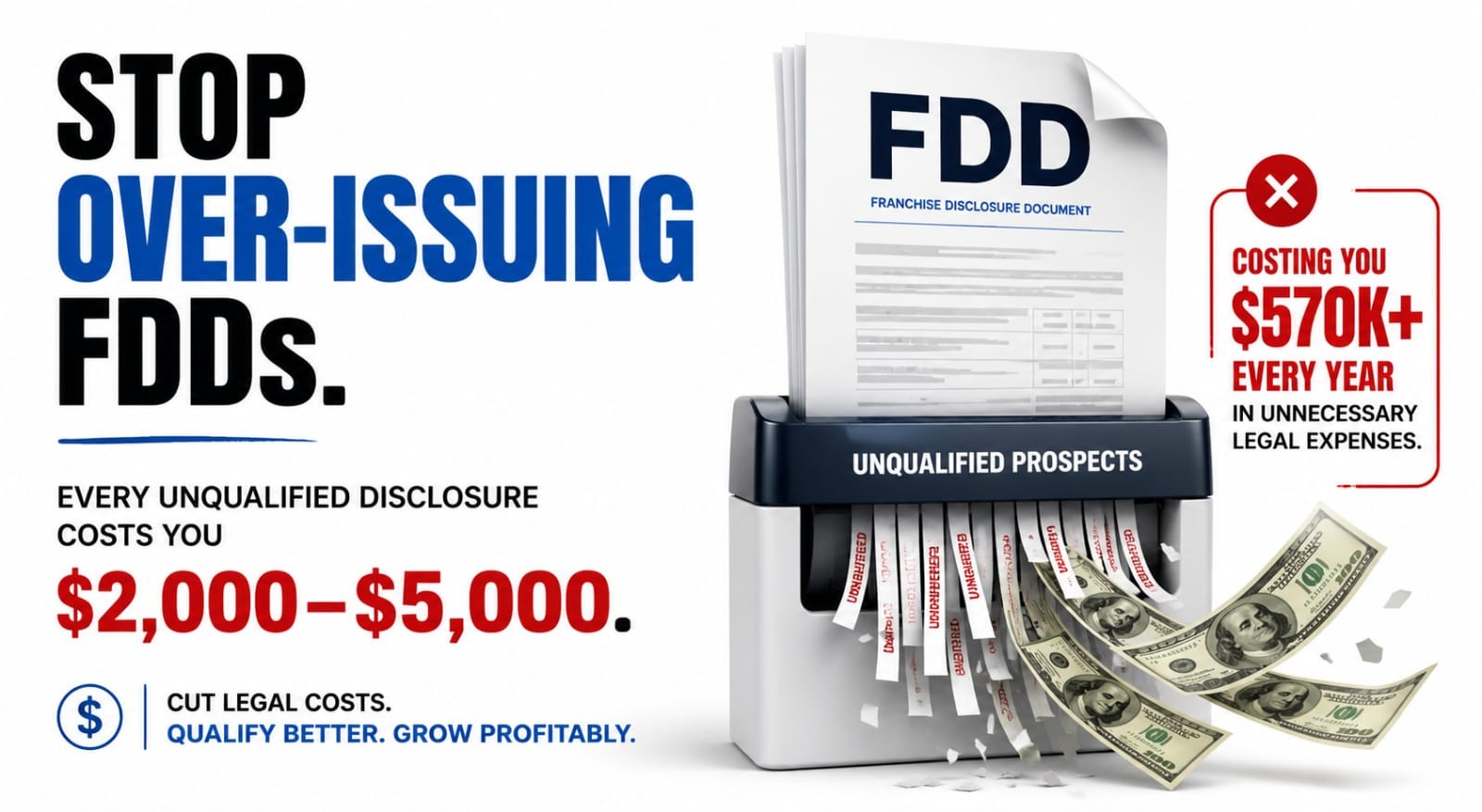
There is a cost buried inside every franchise sales operation that does not appear on any sales report. It sits inside legal retainers, paralegal line items, and compliance hours — costs that are real, recurring, and largely preventable. Every time a franchise development team issues a Franchise Disclosure Document to a prospect who cannot close, someone in legal has just billed $2,000 to $5,000 that will never be recovered. The prospect walks away. The territory stays open. The cost is absorbed quietly — not as a line item, not as a KPI, but as an invisible drain on margin that compounds across every month of the sales calendar.
This is the operational reality inside most Franchise Sales Organisations today: qualification is a judgment call made by humans under pipeline pressure, and judgment calls leak money at scale.
The FDD review cost is only the most visible part of the problem. Behind it sits the cost of attorney time spent on preliminary prospect review, paralegal hours preparing state-specific addenda, and the franchise development consultant hours invested in a prospect who was never financially viable to begin with. In states with their own franchise registration requirements — California, Hawaii, Illinois, Indiana, Maryland, Michigan, Minnesota, New York, North Dakota, Rhode Island, South Dakota, Virginia, Washington, and Wisconsin — the exposure is compounded by the additional compliance work required before disclosure can even occur.
Australian FSOs face equivalent exposure under the Franchising Code of Conduct, enforced by the ACCC, which mandates a minimum 14-day disclosure period before any agreement or payment can be executed. The document preparation cost is comparable — AUD $3,000 to $8,000 per disclosure event in a multi-territory system. Canadian FSOs operating under Ontario's Arthur Wishart Act, Alberta's Franchises Act, or similar provincial legislation in British Columbia and New Brunswick face the same dynamic.
The common thread across every jurisdiction is this: when qualification fails upstream, the legal machinery downstream pays the price.
Most franchise sales organisations measure their development teams on discovery calls booked and FDDs issued — not on franchise agreements signed. The metrics that look like pipeline health are, in many cases, the direct cause of margin destruction. Every incentive in the system points toward forward motion. No incentive points toward qualification rigour.
Why FSOs Over-Issue FDDs: The Structural Failure
The root cause is not laziness or poor judgment. It is structural. Most franchise sales pipelines were designed to capture and advance leads — not to reject them. Every CRM dashboard shows leads moving forward as a sign of health. But in franchise development, a lead moving forward prematurely is not progress. It is a cost transfer to the legal department.
The structural failure operates in four specific leak points:
Lead source quality is uneven, but treatment is uniform. A prospect from a curated broker referral arrives with financial pre-screening already applied. A prospect from a generic web form or franchise portal may have done nothing more than click an ad. Both enter the same pipeline. Both receive the same follow-up cadence. By the time the financial gap surfaces, the discovery call has been scheduled and, in many cases, the FDD preparation has begun.
Sales teams operate under metrics that misalign with qualification rigour. A franchise development consultant measured on discovery calls booked has a structural incentive to advance marginal leads to a call. The qualification gate, where it exists at all, is a judgment call in a conversation — not a system requirement. Judgment calls at scale produce inconsistent outcomes.
Behavioral scoring is absent from most FSO technology stacks. A prospect who has downloaded the investment overview, revisited the territory map twice, and completed the pre-qualification questionnaire looks identical in most CRMs to a prospect who opened one welcome email nine days ago. Both are categorised as 'active.' Both can be forwarded to a discovery call with equal ease.
Territory mismatches are caught late. A prospect who is financially qualified but geographically misaligned — seeking a territory already awarded, reserved, or under negotiation — can move through two or three pipeline stages before the mismatch surfaces. By that point, FDD preparation may already be underway.
Each of these leak points is individually defensible. In aggregate, they constitute a meaningful and recoverable cost problem — one that compounds across every month of the franchise development calendar.
What an Unqualified FDD Cycle Actually Costs
The calculation is straightforward, but most FSOs have never run it explicitly. Consider a mid-size franchise system processing 80 new leads per month across all inbound channels — broker referrals, web forms, franchise portal registrations, and direct inquiries. Under a typical manual qualification process, approximately 35 to 40 percent of those leads advance far enough in the pipeline to trigger FDD review activity before disqualification.
At a conservative average of $2,500 per review cycle, the annual exposure on unqualified FDD issuances alone is significant. A well-designed automated qualification funnel — with intake logic, behavioral scoring, hard financial gates, and territory verification — consistently reduces unqualified FDD issuance by 50 to 65 percent in FSOs that implement it properly.
| Metric | Unautomated Funnel | Automated Funnel | | --- | --- | --- | | Monthly inbound leads | 80 | 80 | | Reach FDD stage unqualified | 32 (40%) | 13 (16%) | | Average legal cost per FDD cycle | $2,500 | $2,500 | | Monthly legal spend on non-closers | $80,000 | $32,500 | | Annualised legal bleed | $960,000 | $390,000 | | Annual margin recovered | — | $570,000+ |
Illustrative model. Assumptions: 80 leads/month, 40% unqualified reach rate without automation, 16% with automation, $2,500 average legal cost per FDD review cycle.
The $570,000 annual recovery is not a technology projection. It is an operational outcome, derived from a conservative model with one structural change: stopping the FDD clock from starting until the prospect has cleared every threshold the system can verify without attorney involvement.
The compounding benefit is close rate. Leads that survive a rigorous automated funnel arrive at the discovery call financially verified, behaviorally engaged, and territory-confirmed. The franchise development consultant is no longer sorting through curiosity traffic. Every conversation is with a prospect who has already self-selected through a meaningful qualification threshold. Discovery-call-to-franchise-agreement conversion rates in FSOs with structured qualification infrastructure consistently outperform those with manual pipelines carrying equivalent lead volume — by a margin of two to three times.
Fewer FDDs issued to better-qualified prospects is not a volume trade-off. It is a margin recapture strategy with a compounding close rate dividend built in.
The Qualification Stack That Stops the Bleeding
Effective pre-qualification is not a single screening step. It is a sequence of gates, each catching a specific category of disqualifying condition before the prospect consumes legal, compliance, or consultant resources downstream.
Gate one — Intake logic with branching qualification. The lead intake form is a qualification instrument, not a contact form. Branching logic routes prospects based on stated liquid capital, net worth, franchise experience, and territory interest. A prospect who indicates liquid capital below the system's minimum investment threshold is not rejected — they are routed to an automated educational sequence appropriate to their stage of readiness. They do not touch a discovery call queue. No consultant time is consumed. No FDD clock is started.
Gate two — Behavioral scoring. CRM platforms — HubSpot, Salesforce, and GoHighLevel among others — can assign weighted engagement scores based on documented behavior. Email opens carry a baseline value. Clicking through to the Item 7 investment overview carries a higher one. Completing the pre-qualification questionnaire, downloading the territory availability map, and returning to the site within 48 hours signals a different category of intent than passive receipt of a drip sequence. Leads below a defined threshold do not advance automatically. They remain in nurture until their score qualifies them for consultant contact, or they age out of the active pipeline.
Gate three — Automated nurturing sequences. A prospect who fails a qualification gate is not a dead lead. They are a lead at an earlier stage of financial or psychological readiness. A structured 6 to 8 week automated sequence — built around educational content covering franchise investment realities, unit economics, Item 19 financial performance representations, and franchisee case studies — maintains relationship warmth without consultant involvement. The sequence filters by engagement. Prospects who interact consistently and complete embedded questionnaires rise in behavioral score. Those who go silent age out. No legal resources are consumed at any point in this sequence.
Gate four — Territory verification before discovery scheduling. Before a prospect can book a discovery call, the system verifies territory availability against the franchise's current award registry. A financially qualified prospect in a closed or reserved territory is flagged before consultant time is committed. They are offered an adjacent territory conversation or placed on a waitlist with automated status updates. No FDD review is initiated for a territory that cannot be awarded.
Gate five — Documented financial confirmation before FDD issuance. The final gate before any legal review begins requires submitted documentation — bank statements, net worth summary, or franchise lender pre-qualification letter. This is not a conversation or a self-reported form. It is a system requirement. Until documentation is received and reviewed, no FDD clock starts. This single gate eliminates the majority of unqualified FDD issuances in FSOs that apply it consistently.
The Close Rate Dividend
The cost reduction case for automated pre-qualification is arithmetically straightforward. The close rate case is more consequential — and typically more persuasive to franchise development leadership that is instinctively protective of pipeline volume.
When every lead that reaches a discovery call has passed through behavioral scoring, demonstrated financial capability, confirmed territory availability, and submitted documentation, the economics of that conversation change structurally. The prospect has already invested meaningful time and effort in self-qualification. Commitment signals are present before the first call. The franchise development consultant is not opening a conversation with an unknown quantity — they are closing one with a pre-qualified buyer.
The downstream effect is not marginal. FSOs that have rebuilt their qualification infrastructure report discovery call volume falling 30 to 40 percent — while signed franchise agreements hold or increase. Legal costs decline. Consultant time is reallocated from qualification to closing. The unit economics of franchise development shift structurally — not because the market changed, but because the pipeline's intake architecture did.
This is the full picture of what automated pre-qualification delivers — not just a direct reduction in unqualified FDD review costs, but the reallocation of every expensive hour in the system toward the subset of prospects most likely to close.
Where the Compliance Exposure Is Highest
The financial exposure from FDD fatigue is not distributed evenly across markets. In the United States, it is sharpest in registration states. California, Hawaii, Illinois, Indiana, Maryland, Michigan, Minnesota, New York, North Dakota, Rhode Island, South Dakota, Virginia, Washington, and Wisconsin each require the FDD to be registered or formally exempted at the state level before disclosure can occur. A prospect who advances through manual qualification and fails a financial check after state registration paperwork has been initiated represents multiple layers of cost: federal disclosure preparation, state registration filing, and attorney coordination time — all rendered unrecoverable.
In Canada, disclosure obligations under Ontario's Arthur Wishart Act, Alberta's Franchises Act, and provincial equivalents in British Columbia and New Brunswick impose specific timelines and formatting requirements. The legal cost structure mirrors the US exposure. An unqualified prospect who reaches the disclosure stage in any of these provinces consumes compliance resources that the franchisor will not recover.
In Australia, the Franchising Code of Conduct requires disclosure at least 14 days before any agreement or payment. For an FSO managing concurrent development across New South Wales, Victoria, and Queensland, unqualified disclosure events represent compounded cost across multiple simultaneous compliance obligations. The ACCC's enforcement posture on disclosure compliance adds a further layer: procedural failures in the disclosure process, even those originating from unqualified prospect interactions, carry regulatory risk.
The qualification automation argument is structurally identical across all three markets. The regulatory labels differ. The operational imperative is the same: stop the legal clock from starting until the prospect has cleared every financial and territorial threshold the system can verify without a billing hour.
Three Errors FSOs Make When They Try to Fix This
The most common corrective move FSOs make when FDD costs attract attention is adding a manual phone screening step before the discovery call. This creates a new bottleneck rather than closing the leak. Screening quality varies by consultant, the data does not enter the CRM in any structured form, and the same borderline lead that would have failed a system gate fails a phone screen six days later — after additional consultant hours have been consumed. The cost is reduced marginally. The structural problem is unchanged.The second error is treating the lead intake form as a marketing conversion asset rather than a qualification instrument. Short, low-friction intake forms designed to maximise completion rates produce high lead volumes with minimal qualification signal. One FSO that optimised its intake form for conversion and tripled monthly lead volume without changing any downstream gate saw its unqualified FDD issuance triple proportionally. The form is the first gate. Optimising it for volume rather than signal degrades every gate below it. The pipeline fills faster and leaks at the same rate.
The third error is implementing behavioral scoring with a generic, uncalibrated configuration. A scoring model built for B2B SaaS treats all page views as equivalent engagement. A franchise-specific model must weight time on the Item 19 page, completion of the investment readiness questionnaire, and attendance at a franchise discovery webinar as categorically stronger signals than a homepage visit or a passive email open. An uncalibrated model advances the wrong leads with algorithmic confidence — which is operationally worse than no scoring at all, because it removes human judgment without replacing it with franchise-relevant intelligence.
The Audit That Should Have Already Happened
FSOs that have restructured their qualification infrastructure report FDD issuance reductions of 50 to 60 percent within the first two quarters of implementation. Close rates on issued FDDs hold or improve. Consultant time shifts from pipeline management to closing. Legal spend on unqualified prospects falls to a fraction of its prior level.
The diagnostic is simple. Pull the last quarter's FDD log. Count how many issued FDDs produced a signed discovery call within 14 days of issuance. Count how many produced a signed franchise agreement within 120 days. Calculate the legal spend on the FDDs that produced neither. If that number is above $50,000 for the quarter, the qualification infrastructure is costing more than the lead generation budget.
The pipeline volume is not the problem. The logic governing what enters that pipeline — and what triggers a legal clock — is.
Nirjan International designs automated pre-qualification systems, behavioral scoring models, and CRM-integrated territory verification workflows for FSOs managing franchise development across the United States, Canada, and Australia. If your FDD issuance volume is not matched by a proportional improvement in close rate, your qualification architecture is leaking margin.
Comments (0)
Be the first to comment.