
Why 70% of Business Brokerage Listings Expire Without a Buyer — And the Data Gap Behind It
By Team Nirjan
The listing had been live for eleven months. Three buyer inquiries. Two signed NDAs. Zero offers. When the seller — a manufacturing business owner who had spent twenty-eight years building the company — finally pulled the listing, his parting words to his broker were simple: "You told me $1.2 million. The market told me nothing."
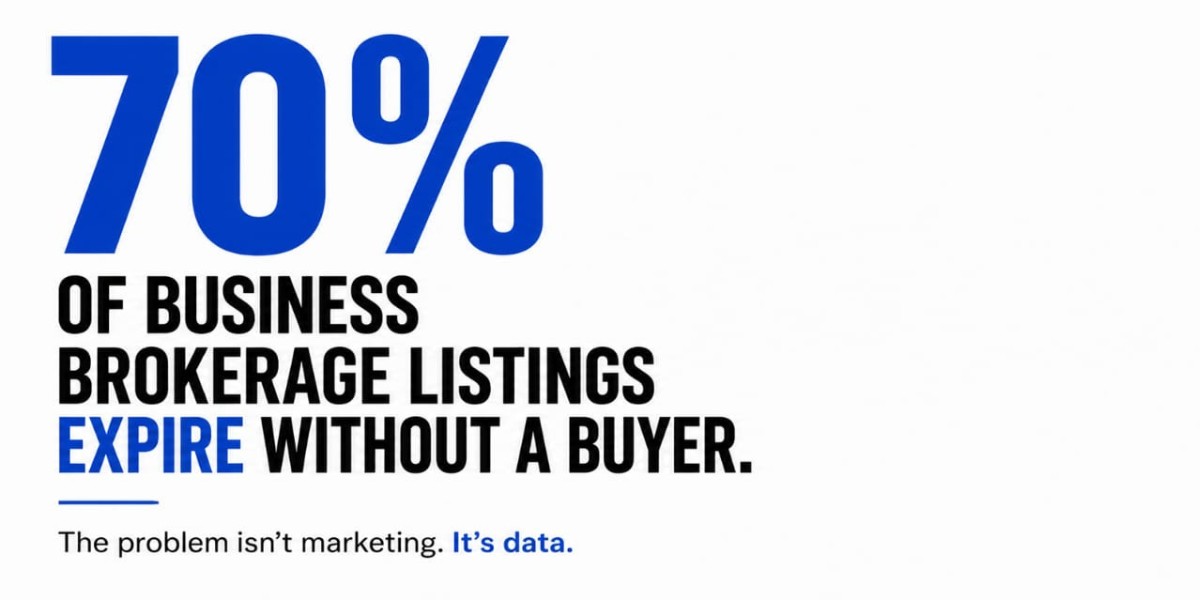
That broker is not incompetent. He is typical. Across the business brokerage industry, roughly 70% of listings expire without ever producing a buyer. Not because the businesses themselves are unsellable, and not because the brokers lack effort. It happens because business brokerage operates without the one thing every other transaction-based industry takes for granted: a reliable, shared picture of what things are actually worth and how the market is actually behaving.
This is not a marketing problem. It is a data problem — and until brokers start treating it as one, the 70% figure will not move.
The Valuation-Confidence Gap: Why Every Listing Is a Guess
Real estate agents operate inside a system most of them never have to think about. The Multiple Listing Service gives them instant access to recent comparable sales — same neighborhood, similar square footage, comparable condition — updated in near real time. A buyer and seller can argue about price, but they are arguing from a shared set of facts.
Business brokerage has no equivalent. There is no centralized, standardized database of recent business sales with verified financials attached. There is no MLS for businesses, and there likely never will be, for reasons that are structural rather than accidental.
Confidentiality is the first reason. Most business sales close under non-disclosure agreements, and sellers — and often buyers — have strong incentives to keep the sale price, terms, and financial performance private. A business owner who sells their HVAC company for $1.4 million generally does not want competitors, employees, or landlords to know the number. That privacy is reasonable, but it means the transaction data that would otherwise build a shared comp database simply disappears into private files.
The second reason is that businesses are not standardized assets the way homes are. A three-bedroom house in one neighborhood is, for valuation purposes, broadly comparable to another three-bedroom house nearby. A landscaping company with $1.2 million in revenue is not automatically comparable to another landscaping company with the same revenue — owner involvement, customer concentration, equipment age, lease terms, and recurring versus project-based revenue can each swing the valuation by 20% or more. Even if a comp database existed, it would need far more dimensions than real estate comps to be useful.
The result is what should be called the valuation-confidence gap: brokers price listings based on a mix of rule-of-thumb multiples, personal deal history, and — uncomfortably often — what the seller wants to hear.
The uncomfortable truth: Many business brokers are not pricing the business, they are pricing the relationship. A broker who tells a seller their $900,000 business is worth $1.4 million wins the listing agreement. Six months later, when the listing has produced silence instead of offers, the broker blames the market, the economy, or buyer hesitancy. Rarely does anyone go back and ask whether the number was wrong from the start.
This dynamic plays out differently across markets. In the US, where BizBuySell publishes aggregate data and the International Business Brokers Association (IBBA) tracks broad trends, brokers at least have directional benchmarks — though nothing granular enough for individual pricing. In the UK, where business transfer agents often operate on a more advisory model with upfront fees alongside success fees, the data gap is even more pronounced: the market is smaller, more relationship-driven, and even less standardized than the US. In Australia, where business broking is regulated state-by-state, the fragmentation compounds the problem further — a broker in Queensland operates under different licensing and disclosure requirements than one in Victoria, and transaction data rarely crosses those boundaries.
The Buyer Black Box: What Happens After the NDA
There is a second, quieter layer to the data gap, and it has nothing to do with pricing. It is the buyer black box — the space between buyer interest and buyer disappearance where most listings quietly die.
Most brokerages have no systematic record of what buyers actually respond to versus what they say they want during an intake call. A buyer might tell a broker they are open to "any service business under $2 million," but their actual behavior tells a much more specific story.
Consider two buyers who both sign NDAs and receive the Confidential Information Memorandum (CIM) for a $1.1 million commercial cleaning company:
Buyer A downloads the CIM within two hours, opens the financial attachment three times, spends eight minutes on the operational description, and asks one follow-up question about owner transition timeline — then goes silent. Buyer B downloads the CIM, opens it once, spends ninety seconds on the financials, and never responds to follow-up.
Without a system that captures this behavior, both buyers look the same: "NDA signed, CIM sent, no offer." The broker moves on. No pattern is recognized. The next listing repeats the same sequence with a different buyer.
But these buyers are not the same. Buyer A’s behavior — repeated financial review and a specific question about transition — suggests serious evaluation, likely weighing this deal against another or working through financing. The silence is not rejection; it is a phase in a decision process the broker has no visibility into. Buyer B’s behavior suggests disinterest from the start. Without buyer behavior analytics, every silent buyer looks identical. With it, the broker can score intent and time outreach to match the buyer’s actual decision cycle rather than the broker’s hope.
Finally, there is the memory problem. The brokers who have closed the most deals — often the most senior people in a firm — carry decades of pricing intuition and market feel in their heads. That intuition is real and valuable. It is also completely unstructured, untransferable, and gone the day that broker retires or leaves. A junior broker inherits the firm's reputation but none of its accumulated market knowledge, because that knowledge was never captured anywhere except in one person's experience.
Put these three gaps together — no transaction comps, no buyer behavior data, no institutional memory — and the picture becomes clear. Brokers are not failing to sell businesses because the businesses are bad. They are failing because they are pricing, matching, and marketing in the dark, and then being surprised when the lights don't come on.
The Math of a Dead Listing
It is worth sitting with what an expired listing actually costs, because most brokerages never calculate it directly — they feel the revenue shortfall at the end of the year without tracing it back to its source.
A typical business brokerage engagement runs 6 to 12 months before a listing either sells or is withdrawn. Across that period, a broker will commonly invest 80 to 120 hours — intake calls, financial package preparation, marketing material development, NDA administration, buyer screening calls, follow-up, and seller management. On a business priced in the $500,000 to $2 million range, a closed transaction typically represents a commission of $50,000 to $150,000, depending on deal size and fee structure. In the US, commissions typically run 8–12% on transactions under $1 million, scaling down to 3–6% on larger deals. UK and Australian structures vary, but the principle is identical: a closed deal represents significant revenue, and an expired deal represents significant waste.
When that listing expires instead of closing, the broker has not simply failed to earn a commission. They have spent 6 to 18 months of calendar time — accounting for re-listing, repricing, and the slow drift toward withdrawal — on a deal that produced nothing. Consider a $750,000 manufacturing business that expires after fourteen months at a 10% commission rate. The broker has not just lost $75,000 in potential commission. They have absorbed roughly 100 hours of unbilled time, spent several thousand dollars on marketing materials, financial packaging, and listing placement, and — perhaps most damaging — they have lost the referral. Sellers talk to other business owners. A seller who watched their listing go nowhere for over a year is not the seller who refers their friends, their accountant's other clients, or the buyer of their building to that broker.
Scale this across a typical book of business. A broker carrying ten active listings in a given year, with a 70% expiration rate, closes three and watches seven expire. If the average commission on a closed deal is $75,000, that broker is leaving roughly $525,000 in potential annual commission on the table — not because seven businesses were unsellable, but because seven listings were priced, marketed, or matched without the information that would have made them sellable.
This is the number that should change how brokerages think about their operations. It is not a marketing budget problem. It is not even, primarily, a sales skill problem. It is the cumulative cost of operating without a feedback system — a brokerage that cannot tell, in real time, whether a listing is underpriced, overpriced, poorly matched, or simply invisible to the right buyers.
From Flying Blind to Data-Driven: The CRM-Enriched Brokerage
The good news is that the data gap, while structural, is not permanent — at least not at the level of an individual firm. While there will never be a public MLS for businesses, a brokerage can build something almost as valuable: its own proprietary, firm-level intelligence layer, built from the deals it has already done and the buyers it already talks to.
This is what a properly configured CRM actually does for a brokerage, and it is a very different thing from what most people picture when they hear "CRM." A generic CRM is a contact list with reminders attached. A brokerage-specific CRM, configured as institutional memory, becomes something closer to a private comp database and a buyer intelligence engine combined.
Start with comps. Every business a firm has listed, marketed, and either sold or failed to sell is a data point. If that information — asking price, final sale price, days on market, industry, revenue range, EBITDA, buyer profile, reason for any price adjustments — is captured systematically rather than left in individual brokers' notes and memories, the firm builds its own internal version of the comp database that the broader industry lacks. After three to five years, a firm that has closed even a modest number of deals in a given sector and region has more relevant pricing intelligence for that specific market than any national aggregate report could provide.
Then there is buyer behavior. Buyer behavior analytics sounds technical, but the underlying idea is straightforward: track what buyers actually do, not just what they say during intake. Which listings does a buyer request information on? How many times do they open the CIM? Do they go quiet immediately after seeing the EBITDA figure, or after seeing the lease terms, or after learning the owner plans to stay involved for two years? Over time, these patterns become genuinely predictive. A firm might discover that buyers with stated liquidity above $500,000 consistently disengage from listings that require an owner-operator transition — a pattern that would let the firm pre-filter which buyers to show which listings, rather than broadcasting every new listing to the entire buyer list and hoping.
The third piece is the automated pricing feedback loop, and this is where the valuation-confidence gap starts to close in practice. Instead of a listing sitting quietly for months while the broker waits and the seller grows frustrated, a CRM-enriched workflow can flag activity thresholds automatically. If a listing has been viewed 200 times with zero inquiries after 60 days, that is a signal — likely a pricing or positioning issue — and it can trigger a structured conversation with the seller well before month eleven, backed by actual engagement data rather than a broker's gut feeling that "something feels off."
This is the shift the brief calls "data transforming from liability to asset." Right now, the absence of data is a liability — it is the reason listings get mispriced and buyers get mismatched. Once a firm starts capturing its own transaction history and buyer behavior systematically, that same information becomes the firm's competitive advantage. Two brokerages in the same city, selling similar businesses, will increasingly differ not in effort or relationships, but in whether one of them can say, with evidence, "businesses like yours, in this market, in this condition, typically sell in four to six months at this multiple — and here's why."
This is the kind of system Nirjan International builds for brokerage firms — not a generic sales CRM repurposed for M&A, but a system structured around the realities of confidential listings, long sales cycles, and buyer profiles defined by liquidity, industry preference, and deal-size appetite rather than simple lead-stage tags. The exact configuration shifts by market — US firms generally need fields built around SBA-financed deals, UK firms need advisory-fee and success-fee pipelines tracked separately, Australian firms need state-specific licensing fields — but the principle is the same everywhere: the CRM is not a contact database. It is a market intelligence engine that accumulates value with every deal.
What a Data-Enabled Brokerage Actually Looks Like
In practice, this starts well before a listing goes live. A data-enabled brokerage builds buyer intake directly into structured CRM fields — liquid capital range, industry preference, geographic constraints, owner-operator versus absentee preference, timeline — rather than letting that information sit in call notes or paper files that only the broker who took the call can interpret.
When a new listing comes in — say, a $1.2 million HVAC business — the CRM can immediately surface a ranked list of buyers who have previously engaged with similar businesses, weighted by actual behavior (CIM opens, follow-up questions, time spent on financials) rather than by how enthusiastically they described themselves during intake. The broker's first move is no longer "who's on my list," but "who, based on their actual history, is most likely to take this seriously."
On the seller side, the same system changes how expectations get managed from day one. Instead of a broker offering a number based on what will win the listing, pricing conversations can be grounded in the firm's own closed-deal history for comparable businesses — turning a potentially uncomfortable conversation about price into a data-backed one. And once the listing is live, the 60- and 90-day activity reviews become routine rather than reactive: a scheduled checkpoint where engagement data, not anxiety, drives the next decision.
The broker from the opening scene was not wrong about the business. He may well have been right that it was worth $1.2 million to the right buyer, at the right time, with the right financing in place. What he didn’t have was a system that could tell him, early, whether the market agreed — or a record of his own past deals to anchor the conversation with his seller from the start.
Listings do not expire because buyers disappear. They expire because brokers lack the visibility to align valuation, demand, and buyer behavior — and that visibility comes not from working harder, but from treating every past deal, every buyer interaction, and every quiet listing as data worth keeping.
If you run a business brokerage firm and you’re ready to turn transaction history into competitive intelligence, the Nirjan International CRM Setup, Management & Optimization team builds these systems specifically for business brokers — closing the valuation-confidence gap one deal at a time.
Comments (0)
Be the first to comment.