
Why Small Consumer Brands Will Win on Community, Not Ads — And the Tech Stack That Makes It Scalable
By Team Nirjan
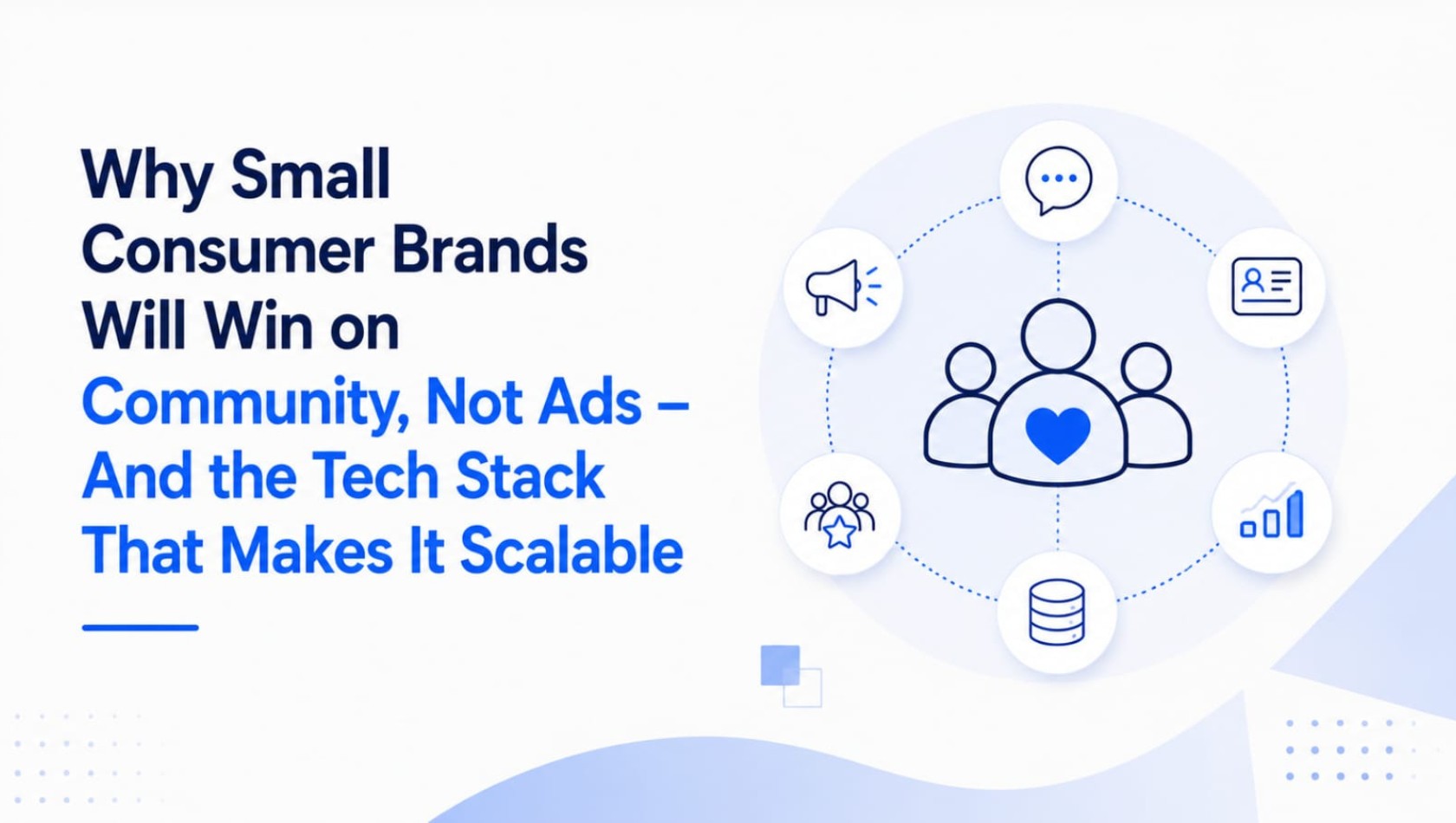
A small consumer brand cannot outspend a national competitor on Meta or TikTok. It never could, and the gap is only widening as acquisition costs climb across paid social. What a small brand can do — and what a well-funded competitor cannot simply buy its way into — is a community that trusts it. That asymmetry is not a marketing platitude. It is the single most durable advantage a small brand has left, and most small brands are wasting it by treating community as a vibe instead of a system.
Walk into the marketing meeting of almost any founder-led consumer brand and you'll hear some version of the same sentence: "We have a great community." What that usually means, in practice, is a founder posting in a Facebook group a few times a month, a Discord server that went quiet after the launch week spike, or an Instagram comment section the brand occasionally replies to. There is no onboarding sequence for new members. There is no way to tell which of the 4,000 people in the group are quietly generating referrals and which have never opened a single post. There is no system for turning a customer's unprompted Instagram Story into usable, rights-cleared marketing material. And there is absolutely no mechanism connecting any of it back to a purchase.
That is not a community strategy. That is an unmanaged asset, decaying in real time while the brand keeps paying rising prices to rent attention from platforms that owe it nothing. This is the gap Nirjan International's work with small consumer brands keeps running into: founders who have real community goodwill and no system underneath it.
The Real Cost of Renting Instead of Owning
Paid acquisition has gotten structurally harder for small consumer brands over the last several years, and the trend line is not reversing. Platform ad costs have climbed steadily since the post-2021 privacy shifts reduced targeting precision, pushing more brands to spend more for the same volume of qualified traffic. Every dollar a small brand spends replacing what an owned audience could deliver for free — repeat purchases, referrals, organic user-generated content, first-party data — is a dollar of margin quietly transferred to an ad platform.
This is the part most founders underweight: research widely cited from Harvard Business Review puts the cost of acquiring a new customer at 5 to 25 times more than retaining an existing one, and Bain & Company's often-cited research on customer loyalty found that a 5% improvement in retention can lift profits by 25% to 95%, depending on the industry. That single fact should reorganize how a small brand allocates its marketing budget. Yet the incentive structure of paid platforms — instant reporting, clean attribution, dashboards that feel like control — keeps pulling small-brand marketing spend toward acquisition and away from the slower, less legible work of building an owned audience.
Community reverses that math over time. It costs more to build in month one than a single ad campaign does. But unlike an ad campaign, it does not reset to zero the day the spend stops. A well-run community keeps generating referrals, repeat purchases, and free content in month twelve at a fraction of what it cost to generate the same outcomes through paid channels in month one. That compounding is the entire argument — and it only holds if the community is actually systematized, not just present.
Why Big Brands Can't Simply Buy This
A large, well-capitalized competitor can outspend a small brand on media in an afternoon. It cannot buy genuine trust, and it cannot manufacture the kind of identity-based loyalty that makes a customer feel like a member rather than a transaction. Community, done properly, is one of the few competitive advantages left where scale of budget does not translate directly into scale of advantage. A ten-person brand with 800 genuinely engaged community members can out-convert a hundred-person brand with a much larger but disengaged social following, because conversion in this context runs on trust, not reach.
That is the moat. But a moat with no infrastructure behind it is just a nice sentiment. The brands that actually capture this advantage over the next few years will be the ones that treat community the way they already treat their sales funnel: as a system with defined stages, owners, and automation — not as an ambient good vibe the founder maintains personally.
The Community Operating Layer: Five Systems, Not One Group Chat
Building a scalable community isn't about picking the right platform — Discord, a private Circle community, a WhatsApp broadcast list, or an Instagram Close Friends list can all work. It's about the operational layer underneath the platform. There are five systems that separate a brand with a real community asset from a brand that just has a chat room with the company logo on it.
1. Welcome and Onboarding Sequences
The first 48 hours after someone joins a community determine whether they become an active member or a silent name on a member list. A real onboarding sequence — an automated Discord bot flow, a short email series, or a WhatsApp broadcast — does three things: it explains what the community is actually for, it gives the new member one easy, low-friction way to participate immediately, and it sets expectations for what they'll get out of staying. None of this should read as a sales pitch. The brands that get this wrong use the welcome sequence to sell; the brands that get it right use it to orient.
2. Engagement Scoring
Not every community member is equally valuable, and treating them as if they are is how brands waste their best relationships on generic mass messages. Engagement scoring tracks who is actually showing up — reacting, posting, attending events, opening content — versus who joined once and never returned. This is the layer that turns a community from a list into something closer to a CRM: a system that tells the brand exactly who to invest attention in next, rather than guessing.
3. UGC Rights Management
This is the part almost no small brand has systematized, and it's a real operational and legal gap hiding behind an otherwise healthy-looking community. When a customer posts organically about the brand, there needs to be an automated way to capture usage rights — not a manual DM asking permission every time content looks reusable. Without this, a brand either can't legally reuse its best organic content in ads and on its site, or it reuses it anyway and quietly accumulates legal risk. A rights-management workflow closes that gap and turns community-generated content into a genuine content pipeline instead of a legal liability.
4. Ambassador Tiering
This is where the distinction the industry blurs constantly needs to be made explicit: an ambassador program is not an affiliate program, and treating them as interchangeable weakens both. An affiliate relationship is transactional — a tracked link, a commission on sales, a purely performance-based arrangement that can scale to anyone willing to share a code. An ambassador relationship is curated and identity-based — a smaller group of people the brand chooses because they already embody what the brand stands for, compensated in status, early access, and product rather than commission alone. A tiered ambassador structure (member → contributor → ambassador → partner, or whatever ladder fits the brand) gives community members something to grow into, and gives the brand a clear, non-arbitrary way to decide who gets more access, more product, and more voice as they prove themselves. Brands that skip the tiering and just call every enthusiastic customer an "ambassador" dilute the term until it stops meaning anything — and stop giving members anything real to work toward.
5. Community-to-Conversion Tracking
None of the above survives a budget conversation unless it can be tied back to revenue. A founder who is used to judging every channel by return on ad spend will not keep funding "community" as a soft, unmeasurable line item indefinitely. Community-to-conversion tracking closes that loop: unique discount codes tied to community cohorts, UTM-tagged links shared inside the community, or CRM tagging that flags a customer as community-sourced at the point of purchase. This is what lets a brand walk into a budget conversation and show, in the same language as its paid channels, exactly what community is generating — and defend the investment on those terms.
Why the Platform Choice Still Matters, Even in a Global Playbook
The five-layer system holds regardless of geography, but the platform layer underneath it shouldn't be copy-pasted across markets. US audiences have normalized Discord and TikTok-adjacent community spaces well beyond gaming and tech niches. UK audiences layer WhatsApp broadcast groups on top of the same platforms, often as the more trusted, higher-open-rate channel for anything that feels personal rather than promotional. Australian consumers show unusually high day-to-day usage of Instagram and TikTok relative to market size, making those the default first stop rather than a secondary channel. Canadian audiences tend to mirror US platform habits closely, though brands targeting Canadian markets specifically often find email and Facebook Groups carry more trust than Discord as a primary community anchor. None of this changes the operational layer — welcome sequences, engagement scoring, rights management, tiering, and conversion tracking work the same way regardless of platform — but a brand that builds its onboarding flow for the wrong channel will simply never get members far enough into the funnel to reach the parts that matter.
What This Looks Like in the First 90 Days
For a small brand starting from scratch, the build order matters more than trying to launch everything simultaneously:
-
Weeks 1–2: Choose the platform that matches where the audience already spends time — Discord and TikTok-adjacent spaces for younger, digitally native audiences in the US; WhatsApp broadcast lists alongside the standard platforms in the UK; Instagram-first community spaces in Australia, where usage is especially high. Build the welcome sequence before inviting a single member.
-
Weeks 3–6: Layer in basic engagement tracking — even a simple tagging system that flags who's active versus dormant is enough to start. Begin manually capturing UGC rights as a bridge until an automated workflow is in place.
-
Weeks 7–10: Design the ambassador tier structure and identify the first cohort of candidates from the most engaged members already surfaced by the scoring system — don't recruit ambassadors cold.
-
Weeks 11–13: Implement basic conversion tracking so the community's revenue contribution is visible before the first quarterly budget review.
The sequence matters because each layer depends on the one before it. Ambassador tiering built on top of engagement scoring works because the brand is choosing ambassadors based on real behavior, not guesswork. Conversion tracking works because there's already a defined, engaged cohort to attribute revenue to.
Building the System Without Enterprise Resources
None of these five layers require the kind of martech budget a venture-backed competitor has access to. A CRM that supports tagging and basic automation, a community platform like Circle, Discord, or a WhatsApp broadcast list, and a lightweight content library are enough to run all five layers at a small-brand scale — the constraint has never really been the tools, it's been treating this as a content and reputation system instead of a chat room someone checks occasionally. What they require is the same operational discipline a brand already applies to its sales funnel, applied to a part of the business most small brands still treat informally.
This is precisely the gap Nirjan International's SMO, SEO, and content branding systems are built to close — turning the raw material a community generates (UGC, testimonials, ambassador content, community conversations) into a structured, rights-cleared content and reputation pipeline, rather than leaving it scattered across screenshots and DMs. A brand doesn't need an enterprise martech stack to run a tiered ambassador program or turn UGC into a renewable content engine; it needs the right handful of systems wired together correctly around a real content branding strategy, which is exactly the kind of infrastructure Nirjan International builds for small consumer brands ready to stop treating community as an afterthought.
A large competitor can always outspend a small brand on ads. It cannot buy the kind of trust that makes a customer show up to a community even when nothing is being sold that day. That advantage is real, but it is not automatic, and it will not survive on good intentions alone. The small brands that win the next few years of consumer competition will be the ones that stop treating community as a nice-to-have side project and start building it as deliberately as they built their acquisition funnel — with onboarding, scoring, rights management, tiering, and attribution all working as one system rather than five disconnected ideas.
If your brand is generating real community engagement but has no system turning that engagement into retained revenue, the Nirjan International team builds community-driven brand growth systems — from UGC automation workflows to full ambassador program tech stacks — specifically for small consumer brands trying to compete on relationships rather than ad spend.
Comments (0)
Be the first to comment.