
The AI Implementation Gap: Why Most Businesses Buy AI Tools But Never Get ROI
By Team Nirjan
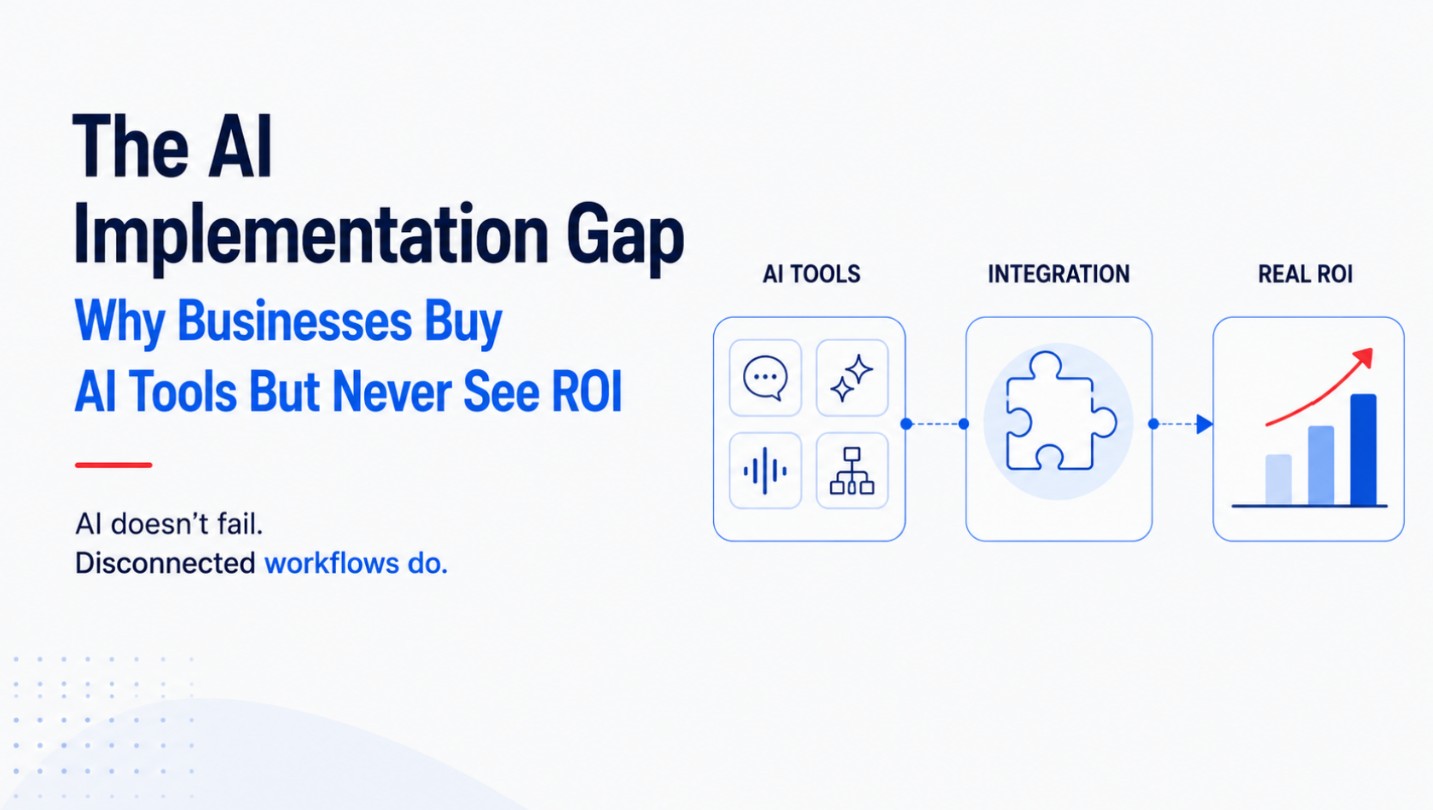
95 percent of enterprise generative AI pilots deliver no measurable financial return. That is not a technology failure — the models work. It is an integration failure, and it has become the single most expensive blind spot in business operations today.
Somewhere in the last two years, most businesses accumulated an AI tool stack the same way businesses accumulated software apps back in 2010: reflexively, one purchase at a time, in response to whatever seemed urgent that quarter. A writing assistant here. A meeting transcriber there. An automation platform bolted on because a vendor demo looked impressive. Nirjan International's work with clients across industries has surfaced the same pattern repeatedly: the result is not transformation. It is sprawl — a collection of AI tools operating as isolated islands, each doing its narrow job well in a demo and doing almost nothing for the business as a whole.
MIT documented the scale of that gap explicitly. A July 2025 study from MIT's Media Lab, published under its Project NANDA initiative, found that despite $30 to $40 billion in enterprise generative AI investment, 95 percent of pilots delivered no measurable financial return. Only 5 percent of deployments reached the point of creating significant, quantifiable value. Researchers called this split the "GenAI Divide" — not a divide between companies that use AI and companies that don't, since adoption is close to universal, but a divide between companies that integrate AI into how work actually gets done and companies that merely bought AI.
That distinction is the subject of this piece.
MIT's researchers were specific about where the failure lives. It is not model quality, and it is not regulation. The core issue, in the report's own framing, is a "learning gap" — the inability of organizations to fold AI tools into their existing workflows, data structures, and operating culture. A generative writing tool can look flawless in isolation and still deliver nothing, because nothing downstream of it changed. The tool produces an output; a human still copies that output into another system by hand; nothing about the underlying process got faster, cheaper, or more accurate.
This is why AI rollouts stall at the same point so often: pilot phase. Teams abandon enterprise-grade systems, in particular, in stages — widespread evaluation gives way to a much smaller group reaching real pilot testing, and only a fraction of those ever reach production. The tools that do succeed share a trait: they succeeded only when a partner who understood the surrounding workflow, not just the model, handled the integration. The operative question is rarely "which model is best." It's "who is making sure this model actually connects to what the team does every day."
There's a quieter signal in the same research: a "shadow AI economy." In more than 90 percent of firms studied, employees kept using personal AI tools — their own ChatGPT or Claude accounts — even after the company's official, sanctioned pilot had stalled. That's telling. It means individual employees are extracting real value from AI every day. The organization, as a system, is extracting almost none. The gap isn't capability. It's architecture.
The Uncomfortable Truth
Most executives assume the fix is more training or a better vendor. It usually isn't. The tool a company is paying for is rarely the tool its own employees actually trust to do the work — and no amount of onboarding fixes a tool that doesn't talk to the systems around it.
A related finding explains a decision most executives don't realize they've made by default: where AI budget goes. The overwhelming majority of enterprise AI investment is concentrated in sales and marketing use cases — content generation, lead scoring, campaign copy. It's an intuitive place to start, since marketing is visible and a new AI tool there is easy to demo to leadership.
But the data shows the ROI is inverted. The highest returns aren't showing up in sales and marketing. They're showing up in back-office automation — document processing, internal workflow handling, compliance tasks, the unglamorous operational plumbing that never gets a stage demo. Back-office use cases have a structural advantage: the workflows are more repetitive and more rule-bound, which makes them easier to automate end-to-end rather than requiring a human to review and rewrite AI output before it's usable.
This is the point-solution trap in practice. A business might have Jasper or Copy.ai generating blog copy, Zapier or Make moving form data between systems, HubSpot AI scoring leads, and Salesforce Einstein running forecasts — four capable tools, none of which share a unified view of the customer. A tool that drafts a sales email but requires a rep to manually copy that draft into the CRM, adjust the tone, and log the activity by hand hasn't automated anything — it has moved the manual work from writing to copy-pasting. Call it the integration tax: every point solution that doesn't hand off its output automatically creates a small, permanent drag that scales with headcount instead of shrinking with it.
If the generative AI wave of the last two years produced a 95 percent failure rate on ROI, the emerging wave of agentic AI — systems designed to take multi-step actions autonomously rather than simply generate content — is on track to repeat the pattern on a shorter timeline. Gartner predicted in mid-2025 that more than 40 percent of agentic AI projects will be canceled before the end of 2027, citing escalating costs, unclear business value, and inadequate risk controls.
Crucially, Gartner's analysts were explicit that model capability isn't the cause of the coming cancellations. The failures trace back to governance, unclear ownership of the AI agent's decisions, and — again — a lack of integration discipline before deployment. Gartner has also flagged what it calls "agent washing," where vendors rebrand existing chatbots or automation tools as "agentic AI" without meaningful autonomous capability behind the label. A business evaluating a new agentic tool today may, in many cases, be evaluating a repackaged version of technology that already failed to deliver ROI under its previous name.
The lesson compounds. Every AI wave so far has rewarded the same order of operations — clear business case first, integration plan second, tool purchase last — and punished the reverse.
Adoption data consistently shows UK and Australian businesses trailing US adoption by roughly six to twelve months. In most technology cycles, most read that as a disadvantage. Here, the opposite case is stronger. The businesses that adopted earliest in the US are precisely the ones generating the 95 percent failure statistic — the ones that bought first and integrated never.
A business evaluating its AI strategy in London, Manchester, Sydney, or Melbourne today is not behind. It's positioned to skip the expensive, failed first draft entirely: prioritize workflow integration over point solutions, direct spend toward operational processes rather than the flashiest customer-facing use case, and involve an implementation partner from the outset rather than after eighteen months of an unintegrated pilot. The lag is a planning window, not a deficit — provided it's used deliberately rather than simply delaying the same mistakes by a year.
Before purchasing another AI license, a business should run a structured audit against six dimensions. This isn't a procurement checklist — it's a diagnostic for what's actually happening underneath the adoption numbers.
Workflow Coverage
Does the tool improve one isolated stage, or does it carry context across the full process?
Diagnostic question: If this step is automated, where does the output go — automatically into the next system, or into a spreadsheet someone emails around?
Red flag: High performance on one task, zero improvement on handoff time.
Integration Depth
Does the tool fit existing workflows, or does it force changes employees quietly work around?
Diagnostic question: How many steps sit between an employee finishing work in one system and the AI tool picking it up?
Red flag: Requires a separate tab, a manual copy, or re-entering context the original system already has.
Context Retention
Does the tool learn the business's data across sessions, or start from zero every time?
Diagnostic question: If the same question comes up next week, will it remember what it was told about pricing, approval hierarchy, or customer segments?
Red flag: The tool treats every prompt as a first conversation.
Coordination
Can tools hand off work to each other coherently, or does each operate in isolation?
Diagnostic question: When the CRM flags a lead as hot, does outreach, scheduling, and follow-up sequencing react automatically — or does someone still export a CSV?
Red flag: "Download as CSV" standing in for integration.
Governance
Can the business trace what the AI did, when, and why?
Diagnostic question: If a regulator, auditor, or customer asks why a decision was made, is there a clear data trail — or just "the AI suggested it"?
Red flag: Per-tool logging with no unified audit trail.
Scalability
Does the value hold at ten times the current team size, or does overhead grow in lockstep with adoption?
Diagnostic question: If twenty more users were added tomorrow, would admin burden stay flat — or require configuring and troubleshooting each one individually?
Red flag: Works cleanly for three power users, breaks at thirty.
Run this against every AI tool currently licensed. There's also a simple gut-check worth applying to any individual tool: net time saved is the time it saves minus the time spent prompting it, editing its output, and switching context to use it. A tool that saves fifteen minutes of drafting but costs five minutes of prompting, eight of editing, and four of reformatting into another system hasn't saved time at all — it's produced a net loss dressed up as productivity.
Tools that score poorly across several of these six dimensions aren't assets sitting idle. They're recurring costs actively working against the business they were bought to help — and in most organizations that run this audit honestly, a large share of licensed AI seats turn out to be paying for exactly that.
Businesses don't need more AI tools. They need someone to architect how the tools they already have connect to actual outcomes. This is the exact problem Nirjan International's automation and AI workflow integration service is built around — mapping an existing stack against real business processes, closing the gaps between tools that don't talk to each other, and building workflows where AI moves work forward instead of creating another dashboard to check.
When Nirjan International audits a client's stack, the first question is never "what should you buy next." It's "what workflow should this tool actually own." That reframing alone tends to surface redundant licensing and disconnected point solutions before a single new integration gets built.
None of this argues against AI adoption. The businesses extracting real value from AI aren't succeeding because they found a better model — they're succeeding because they treated integration as the actual project and the tool purchase as a minor detail within it. For businesses that haven't made a major AI investment yet, or made one and can't point to a clear ROI figure from it, the AI Stack Audit is the move available now: not buying the next tool, but auditing the ones already sitting in the stack.
If you're a business leader looking to turn an accumulated AI stack into a connected operational system, the Nirjan International Automation & AI Workflow Integration team builds these systems specifically for your operational reality. Start with the audit. The tools can wait.
Comments (0)
Be the first to comment.