
The Residential Broker's Commission Compression: How Technology Is Forcing a Business Model Reinvention
By Team Nirjan
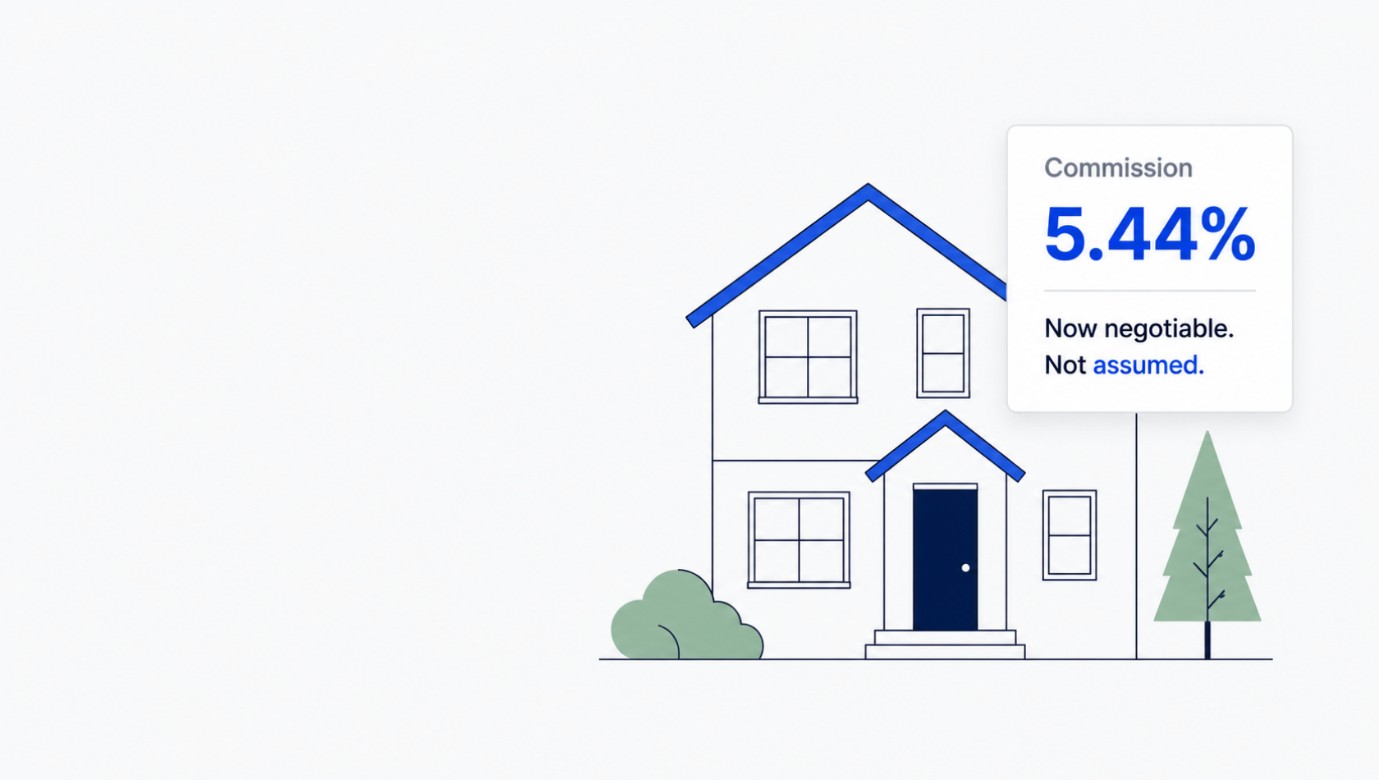
The average US real estate commission is 5.44% — higher than it was the year before. And yet nearly 37% of recent home sellers say they negotiated or tried to negotiate their agent's fee, a rate that would have been almost unheard of a few years ago. Those two facts shouldn't coexist. If the price is going up, why is everyone suddenly haggling over it?
The answer is that the number on the closing statement was never the real story. What's changed isn't the rate — it's whether the client can see what they're paying for, question it, and walk away from it. Most brokers built their entire business on the assumption that they never would.
For decades, the commission was baked into the price of the home before a single showing took place, split between the listing agent and the buyer's agent, and nobody negotiated it because, structurally, almost nobody could see it clearly enough to negotiate it.
That structure is now being pulled apart by three forces working at once: regulatory unbundling, fee-model experimentation, and AI-driven valuation tools that have quietly closed the information gap the old commission model depended on. The result isn't a commission collapse — it's a bundled, one-price-fits-all service being forced to compete, line item by line item, against clients who can now see, and increasingly negotiate, each piece of it separately. Brokers navigating this shift with an operational partner like Nirjan International are approaching it as a systems problem to solve deliberately, rather than a series of individual client conversations to improvise.
The Uncomfortable Truth: The Commission Rate Isn't Falling. The Bundle Is Breaking.
Here's what most industry commentary gets wrong. In March 2024, the National Association of Realtors agreed to a $418 million settlement, and by August 2024 new rules were in effect: sellers are no longer required to offer buyer-agent compensation through the MLS, and buyers must sign a written agreement disclosing exactly how their agent will be paid before touring a home. The expectation across the industry was that this would crater commission rates.
It didn't. One year after the settlement took effect, the average national total commission rate actually stood at 5.44%, up from 5.32% the year before — with rates rising in 39 states and falling in only 10. Sellers, it turns out, are still largely choosing to offer buyer-agent compensation, because homes that don't tend to attract fewer qualified offers.
So if the headline rate barely moved, why does this matter? Because averages hide where the real pressure is landing. On homes priced at $1 million or more, the average buyer's agent commission has already dropped to 2.17% — down from 2.30% a year earlier — because high-value transactions give agents room to discount while still walking away with a healthy dollar figure. Nearly 37% of recent home sellers report negotiating or attempting to negotiate their agent's commission, a figure that was functionally negligible before the settlement made compensation a required, upfront conversation rather than a buried assumption.
This is the uncomfortable truth brokers need to sit with: the commission isn't disappearing, but it is becoming visible, itemized, and negotiable for the first time in the modern history of the industry. A broker whose entire value proposition is "I'll handle everything for a flat 3%" is now being asked, transaction by transaction, to justify what that 3% actually buys.
Three Forces Compressing the Old Model
-
Regulatory unbundling. The NAR settlement's core mechanism — decoupling seller-paid compensation from the MLS and requiring signed buyer agreements before showings — didn't set a price ceiling. It did something arguably more disruptive: it made commission a conversation instead of an assumption. Once a client has to actively agree to a number in writing, that number becomes something they compare, question, and shop.
-
Flat-fee and discount-brokerage experimentation. In the US, Redfin has long operated on a 1–1.5% listing fee model, and similar discount structures have proliferated among independent brokerages chasing the same value-conscious seller. In the UK, Purplebricks is instructive: it launched in 2014 on a flat upfront fee (as low as £999), dominated the online-agent category, then was sold for a nominal £1 in 2023 after years of losses — and by 2025 had moved away from the flat fee entirely, shifting to a "freemium" model monetized through referral commissions on mortgages and conveyancing. In Australia, similar flat-fee entrants like Purplebricks AU and NoAgent target the same value-conscious seller, against a market standard of 2–3%. The pattern across all three markets is the same: flat-fee models don't kill the commission structure outright, but they permanently change what a full-service broker has to prove to justify a percentage-based fee.
-
AI-driven valuation and iBuyer tools. Automated valuation models have eroded the information asymmetry that used to be a broker's core value: knowing what a home is actually worth. iBuyers like Opendoor built entire businesses on removing the listing process altogether — instant cash offers, no showings, a closing date the seller controls. But the iBuyer model itself has struggled to prove it's economically durable at scale. Opendoor remains the largest US iBuyer, purchasing roughly 8,200 homes in 2025, but that was down sharply from 14,700 the year before, and the company reported just a 1% contribution margin per home in its fourth quarter of 2025 after a double-digit year-over-year revenue decline. Zillow exited iBuying entirely in 2021; Redfin shut down its RedfinNow iBuyer arm in 2022. The lesson for brokers isn't "iBuyers are winning." It's that automated valuation and instant-offer technology has permanently changed buyer and seller expectations around speed and price transparency — even where the iBuyer business model itself is still searching for stable footing.
Put together, these three forces don't eliminate the residential broker. They eliminate the version of the residential broker who competes purely on being available and personable, with pricing and process expertise as an unstated given. What's left standing is a smaller set of clearly differentiated business models — and brokers who haven't chosen one yet are the ones getting compressed from every direction at once.
The Cost of Standing Still
The risk isn't a single dramatic drop in what a brokerage earns. It's slower and more corrosive than that. A broker still pricing every client the same undifferentiated way is now competing for the same transaction volume against a widening field: discount brokerages advertising a lower headline rate, buyers who've been legally required to negotiate a number they used to never see, and — at the top of the market, where the data shows commissions compressing fastest — sellers with the most leverage and the least patience for a broker who can't explain what the fee actually buys.
None of this shows up as a single bad quarter. It shows up as a slow erosion in blended commission per transaction, a growing share of listings where the seller successfully negotiates the fee down, and — eventually — a roster of clients who chose a competitor because that competitor could answer the "what am I actually paying for" question and the incumbent broker couldn't. A brokerage that waits for the erosion to become visible in its own numbers before responding is choosing to find out the hard way, deal by deal, exactly how much negotiating leverage it quietly handed to its clients.
Three Viable Business Models for the Post-Bundle Broker
1. The Advisory Retainer Model
Instead of pricing the entire transaction as one undifferentiated percentage, some brokers are unbundling their own service into what it actually is: pricing strategy, negotiation expertise, and transaction management, each billed or retained separately from the sale itself. This mirrors what buyer-agent agreements already require under the new disclosure rules — an explicit, negotiated fee for a defined scope of work, rather than a percentage that only becomes visible at closing.
The retainer model tends to work best with clients who are already comparison-shopping — investors evaluating multiple properties over months, relocation buyers working across an unfamiliar market, or sellers with complex properties who need sustained strategic input rather than a single transactional push. In each case, the client is paying for judgment and access, not just paperwork execution, and that distinction has to be visible in how the fee is structured and communicated from the very first meeting.
What it requires operationally:
-
A CRM structured around service tiers, not just contact stages, so a retainer client and a full-commission client are tracked and nurtured differently from the first conversation, with different follow-up cadences and different reporting expectations built in
-
Clear, written scope-of-service documentation the broker can produce at the point of engagement — the exact document buyer-agreement disclosure rules now make table stakes anyway, so a broker who has already systemized this has a head start rather than a compliance burden
-
A landing page built around the retainer offer specifically, not a generic "contact an agent" page, since a retainer client is evaluating a different value proposition than a commission client and needs to see that reflected in the first thing they read
-
A structured intake questionnaire that qualifies whether a prospective client actually fits the retainer model before the broker invests time in a conversation that assumes the old commission-only framework
2. Automated Investor-Client Matching
Investors — landlords building rental portfolios, house flippers, 1031-exchange buyers — represent a segment where speed and deal flow matter more than hand-holding. Brokers repositioning around this segment function less like a traditional agent and more like a deal-flow curator, matching investor buy-boxes (price range, cap rate targets, property condition tolerance) against inbound listings before they hit the open market.
This model rewards brokers who can move faster than the open market, which means the broker's real product is the speed and precision of the match, not the relationship itself. An investor with a defined buy-box doesn't need to be persuaded that a property is a good fit — they need to see the fit before a competing investor does, and they need the broker's system to filter out the properties that don't qualify without wasting their time.
What it requires operationally:
-
An automated lead-qualification workflow that scores incoming listings and investor inquiries against defined criteria, rather than a broker manually cross-referencing spreadsheets
-
Integration between the brokerage's lead intake and its client database, so a new listing that matches an investor's buy-box triggers an automated alert instead of depending on the broker remembering who wants what
-
A dedicated intake funnel — often a landing page purpose-built for investor buyers — that captures buy-box criteria upfront rather than routing investors through the same generic seller/buyer intake as a first-time homebuyer
-
A follow-up sequence that treats matched leads with urgency (same-day alerts, not weekly digests), since deal flow is the entire value proposition and a delayed notification is a lost transaction
3. High-Touch Concierge Service
At the other end of the spectrum, some brokers are doubling down on differentiated, systemized full service — the model most defensible in competitive, high-price-point markets where commissions compress fastest, precisely because sellers there have the most leverage and the least patience for a broker who can't justify the fee. The risk is that "concierge" becomes a marketing label without an operational backbone — a claim that erodes trust the moment a client compares notes with someone who got the same generic treatment elsewhere under the same label. It only survives scrutiny as a demonstrable, structured service layer — staging coordination, pre-listing repair management, a documented communication cadence — with every element treated as a deliverable with a defined owner and timeline, not a personality trait.
What it requires operationally:
-
A defined, repeatable service checklist the client receives at engagement, turning "concierge" from a marketing word into a documented deliverable
-
Workflow automation that handles the administrative layer (scheduling, vendor coordination, status updates) so the broker's actual time goes toward the negotiation and strategy work that justifies the premium fee
-
Client-facing systems — automated status updates, a structured onboarding sequence — that make the premium visible throughout the transaction, not just implied by the final invoice
Regional Differences Brokers Should Not Ignore
The pressure isn't identical everywhere, and a broker applying a US playbook unchanged in another market will miss what's actually driving the compression locally.
In the US and Canada, the driving force is regulatory: the NAR settlement's decoupling requirement and mandatory buyer-agreement disclosures are the proximate cause of the negotiation increase, and commission structures still generally sit in the 5–6% (USD/CAD) range even as the composition of who pays what shifts.
In the UK, the terminology and the pressure both differ — "estate agent," not "broker," and typical commission already sits lower, in the 1–3% range, because the flat-fee online agent category (Purplebricks and its successors, along with a wave of smaller online agents) normalized a lower-cost expectation years before the US settlement made headlines. The lesson from Purplebricks' own trajectory — flat fee to freemium — is directly relevant here: UK sellers are comfortable with unbundled pricing, but the specific unbundled model that survives (upfront flat fee versus referral-fee-subsidized "free" listing) is still being worked out in real time.
In Australia, commission (AUD) typically runs 2–3%, and flat-fee entrants like Purplebricks AU and NoAgent have applied similar pressure to the UK pattern, though with less market penetration to date. Brokers in the Australian market pivoting toward retainer or investor-matching models should expect a slower adoption curve among sellers than their UK counterparts, simply because the flat-fee alternative hasn't reached the same brand recognition.
What This Means for Brokers Right Now
The brokers most exposed in this shift aren't the discount operators or the luxury concierge specialists — they're the ones in the middle, still pricing every transaction the same way regardless of client type, competing purely on availability and personality in a market where clients can now see the fee, question it, and compare it. Choosing a model — retainer, investor-matching, or concierge — isn't optional positioning anymore; it's the only way to make a commission conversation defensible when the client is legally required to have that conversation before they'll even tour a home.
This is where the operational systems matter as much as the strategic choice. A broker who decides to pivot to an advisory retainer model but still runs their CRM, intake, and follow-up exactly as they did under the old bundled-commission approach hasn't actually changed their business — they've just relabeled it. Nirjan International works with residential and commercial real estate brokers specifically on this operational layer: building the CRM segmentation, automated lead-qualification workflows, and dedicated landing pages that make a chosen business model function in practice, not just on paper.
For a brokerage evaluating an investor-matching pivot, for example, Nirjan International's approach typically starts with mapping the existing lead sources against the buy-box criteria investors actually care about, then building the automated matching and alert workflow around that — rather than layering new technology onto an intake process still designed for a single generic homebuyer.
The Choice in Front of Every Broker
The 5–6% bundled commission isn't vanishing overnight — the data confirms the headline rate has barely moved. But the assumption that justified it — that clients couldn't meaningfully evaluate what they were paying for — is gone, and it isn't coming back. Regulatory disclosure requirements, flat-fee competitors, and AI-driven valuation tools have made every part of the transaction visible in a way it never was before. Brokers who pick a defensible model — retainer, investor-matching, or concierge — and build the operational systems to support it will be the ones still standing when the next round of compression arrives. Those who keep selling the same undifferentiated bundle at the same undifferentiated price are the ones who will keep getting negotiated down, one written agreement at a time.
If you're a residential or commercial real estate broker looking to move beyond the traditional commission model, the Nirjan International team builds automated CRM and lead-matching systems for real estate brokers, designed around the specific business model you choose to compete on.
Comments (0)
Be the first to comment.