
Commercial Real Estate's Lead Gen Crisis: Why Cold Calling Died and Nobody Has a Replacement
By Team Nirjan
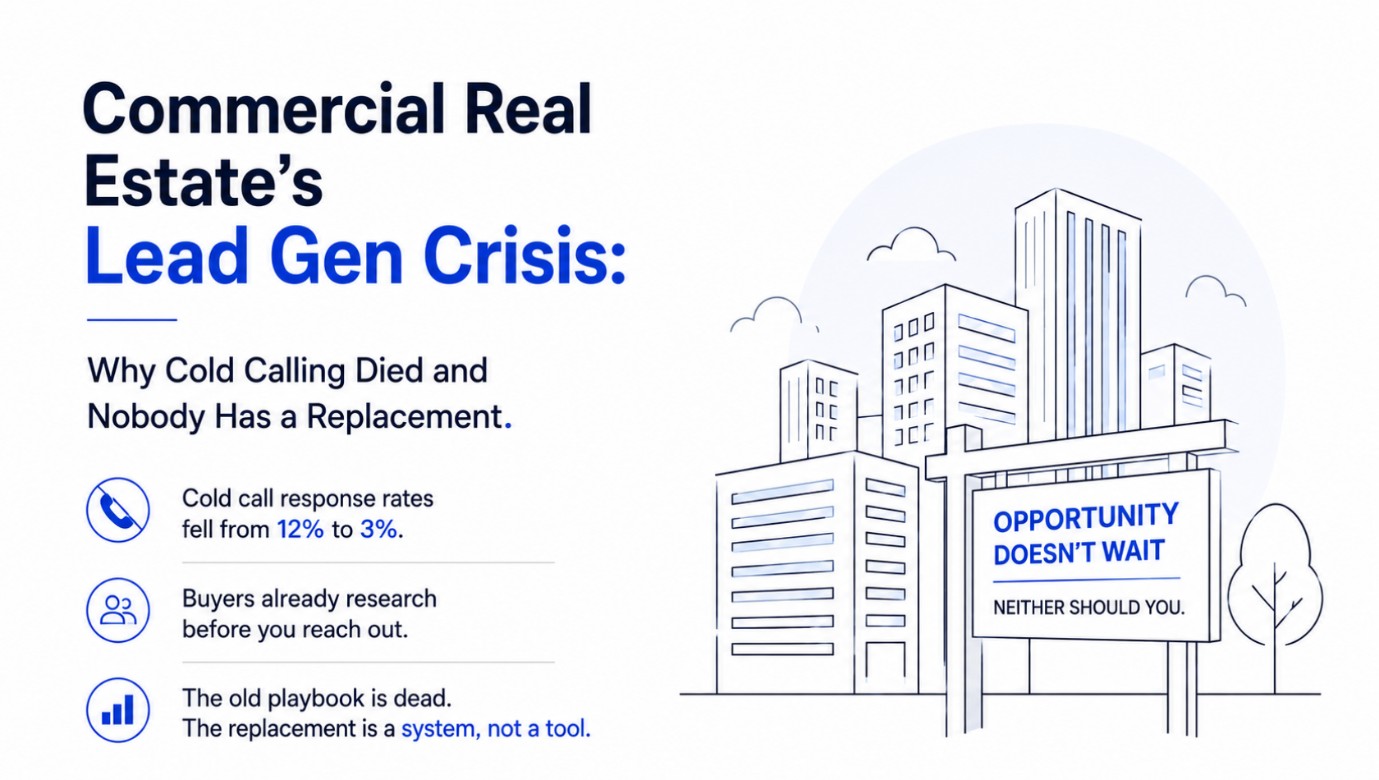
For forty years, the commercial real estate brokerage model ran on two engines: cold calls and referrals. A broker built a book of business by dialing property owners, showing up at industry events, and letting satisfied clients pass their name along. It was slow, but it worked, because the person on the other end of the phone had few other ways to learn what was happening in their market.
That assumption no longer holds. Cold call response rates across real estate have fallen from roughly 12% a decade and a half ago to somewhere around 3% today, and the reason isn't that people have gotten ruder or busier. It's that the call now arrives too late in the decision-making process to matter. By the time a broker picks up the phone, the prospect has usually already researched comparable listings, checked ownership records, read market commentary, and formed an opinion about who seems credible. The call isn't an introduction anymore. It's an interruption of a decision that's already half-made.
This is the uncomfortable part most brokerages haven't confronted: moving cold calling to LinkedIn DMs is not a replacement for cold calling — it's cold calling with a worse reputation cost. Sending fifty unsolicited connection requests a week with a pitch attached is the same volume-based, unsolicited approach that stopped working on the phone. Swapping the channel doesn't fix the mechanism. The brokers actually generating consistent deal flow in 2026 have done something structurally different: they've inverted the funnel, building visibility and data-backed credibility before any direct outreach happens, so that when contact is finally made, it reads as confirmation of expertise rather than a stranger asking for a meeting.
Why the Old Model Is Breaking, Not Just Slowing Down
The decline in cold-calling effectiveness isn't really about phone etiquette. It's about three structural shifts happening underneath the CRE market at the same time.
First, buyer and tenant research now happens before the broker is ever contacted. Investors and corporate real estate decision-makers pull comparable transaction data, ownership history, and market trend data from public and semi-public sources well before reaching out. A broker's digital footprint — their LinkedIn activity, their market commentary, their visibility in the channels a decision-maker already uses — is doing the work a first phone call used to do. Brokers who look credible and informed online are warming up the conversation long before outreach starts. Brokers who don't have that footprint are starting from zero on every call, no matter how good their pitch is.
Second, contact data itself has become unreliable at scale. CRE prospecting depends on knowing who owns what, who's approaching a lease renewal, and who's actively expanding. That information is scattered across county assessor records, LLC ownership structures, brokerage CRMs, and spreadsheets that rarely sync with each other. A contact list that was accurate six months ago is often stale today — the owner sold, the tenant renewed early, the decision-maker changed roles. Cold calling off a decaying list doesn't just underperform; it actively damages a broker's credibility when the information is visibly out of date.
Third, the volume of commercial and multifamily debt maturing in the current cycle has raised the stakes without making prospecting any easier. A large share of outstanding commercial and multifamily mortgage balances matured in 2025, which means urgency and deal activity are both elevated — but so is competition for the same qualified conversations. More brokers are chasing the same signal at the same time, which means speed and precision matter more than raw call volume ever did.
Put together, these three shifts explain why "just call more people" stopped being a viable strategy. The problem was never effort. It was that effort applied to a broken information layer produces diminishing returns no matter how disciplined the broker is.
The Cost of Standing Still
It's worth putting a number on what this actually costs a brokerage, because "leads are harder to get" doesn't land the same way as a commission figure does.
CRE commission structures typically run 3–6% on a lease and 1–4% on a sale, which means a single missed signal — a lease expiration a competitor caught first, an owner who quietly listed with someone who'd already built a relationship through content rather than cold outreach — can represent a five- or six-figure loss on one deal. Multiply that across a book of business relying on a prospecting method with a 3% response rate, and the math stops being about marketing spend and starts being about lost deal flow that never even registered as a missed opportunity, because the broker never knew the signal existed in the first place.
That's the real cost of inaction here: not wasted hours on the phone, but deals that closed with someone else because that broker's information arrived first.
The Framework: Three Layers, Not a Tactic List
Most content on this topic reduces the fix to a flat list — "post on LinkedIn, try Sales Navigator, buy some data." That misses how these pieces actually fit together. The brokers building durable pipelines are running three distinct layers simultaneously, each doing a different job.
Layer One: The Visibility Layer
This is LinkedIn thought leadership, and it only works if it's built around market insight rather than listing promotion. CRE professionals who post consistent, data-backed market commentary see measurably more profile views and connection requests than those who post sporadically or only when they have a listing to push. The content that performs isn't "new listing available" — it's "here's what's happening in your submarket and why it matters to you right now." That distinction is the difference between content that builds authority and content that reads as an ad.
Practically, this means a weekly cadence built around a small number of repeatable content pillars: submarket vacancy and rent trends, notable transactions with a broker's read on what they signal, and commentary on regulatory or interest-rate shifts affecting a specific asset class. None of it needs to be long-form. It needs to be consistent enough that a prospect who eventually gets a Sales Navigator message recognizes the name.
Layer Two: The Targeting Layer
This is where Sales Navigator for brokers earns its place, and it does a job a public LinkedIn search structurally can't. Sales Navigator lets a broker build saved searches around firmographic and behavioral filters — company headcount growth, industry, geography, seniority of role — and get alerted when a company matches criteria suggesting a real estate need is forming. A broker tracking industrial tenants, for example, can build a saved search around manufacturing and logistics companies showing headcount growth in a specific metro, then get notified as qualifying companies appear or as key contacts change roles.
The workflow that actually produces meetings looks like this: identify a decision-maker through a saved search, engage with their content or a mutual connection first rather than messaging cold, then reach out referencing something specific and current — a piece of market data relevant to their situation, not a generic introduction. This is slower per-contact than a cold call, but it converts at a meaningfully higher rate because the prospect isn't meeting a stranger.
Layer Three: The Intelligence Layer
This is the layer most CRE content gets vague about, and it's worth being precise here because it's genuinely two different things wearing the same label.
Buyer and tenant intent signals track expansion or contraction activity continuously — funding announcements, hiring spikes, new job postings in a target market, approaching lease expirations — so a broker sees a company's space need forming before it becomes a public search. Instead of a broker manually checking job boards and press releases hoping to catch a signal before a competitor does, this runs in the background and surfaces qualified prospects with a complete profile already attached.
Property and seller intent signals work the other direction, using listing and ownership behavior — price reductions, days on market relative to the submarket average, ownership tenure, changes in listing agent — to flag properties where an owner is likely to become flexible or ready to transact, sometimes before a formal listing ever appears.
The technology underneath property matching automation has also shifted from rigid filter-based search — pick an asset type, set a price range, define a radius — to something closer to natural-language, intent-based matching, where an investor can describe a deal in the terms they actually think in rather than fitting their criteria into dropdown menus. That shift closes a real gap between how experienced CRE professionals evaluate opportunities and how the tools around them have historically worked.
None of this replaces the broker's judgment. It replaces the hours a broker used to spend manually assembling a picture that a well-built system can now surface automatically — which means the broker's time goes toward the conversations that are actually ready to happen, not toward finding out which conversations exist.
Building the System, Not Just Running the Tactics
The mistake to avoid is treating these three layers as separate initiatives that get picked up individually and dropped when they don't show immediate results. They work because they feed each other: visibility content builds the credibility that makes a Sales Navigator outreach message land differently, and intent signals tell a broker exactly when that outreach should happen rather than leaving timing to guesswork.
This is precisely the gap Nirjan International's approach is built to close for real estate brokerages specifically — not by selling a broker another software subscription, but by building the connective layer between content, targeting, and intent data so the three actually function as one pipeline instead of three disconnected efforts. A brokerage doesn't need more tools bolted onto an existing process. It needs the process itself rebuilt around where deal-relevant information actually surfaces first.
Regionally, the terminology shifts even where the underlying problem doesn't. In the US and Canada, "commercial real estate broker" is the standard term. In the UK, the equivalent professional is more often called a commercial property agent, and RICS-qualified professionals are specifically chartered surveyors — a distinction worth knowing before assuming US terminology translates directly. In Australia, "commercial property agent" and "real estate agent" are both used depending on the state and the transaction type. The mechanics of the crisis — decaying contact data, information arriving too late, cold outreach converting at a fraction of its former rate — hold across all four markets, even where the job title on the business card changes.
The 36-Month Window
The brokers who build this digital pipeline now — visibility, targeting, and intelligence working together rather than as three separate experiments — are the ones positioned to own their markets over the next three years, simply because the information advantage compounds. A broker who's been building submarket authority and running intent-based prospecting for two years has a depth of trust and a speed of information that a broker starting from a cold list can't replicate quickly, no matter how many calls they make.
Cold calling isn't dead because people stopped answering their phones. It's dead because it was built for a market where information moved slowly enough that a phone call could be someone's first exposure to a broker. That market doesn't exist anymore, in CRE or almost anywhere else. The replacement isn't a single new channel — it's a system that gets a broker's expertise in front of the right person before they've decided who they trust, and gets the right signal in front of that broker before a competitor sees it.
If you're a commercial real estate broker looking to rebuild your pipeline around where deals actually start now, the Nirjan International team building LinkedIn Ads and Sales Navigator systems for brokers builds exactly this kind of pipeline — one built for the operational reality of a brokerage, not a generic marketing playbook borrowed from another industry.
Comments (0)
Be the first to comment.