
Why Franchise Brokers Are Losing 40% of Qualified Leads to Poor CRM Handoffs
By Team Nirjan
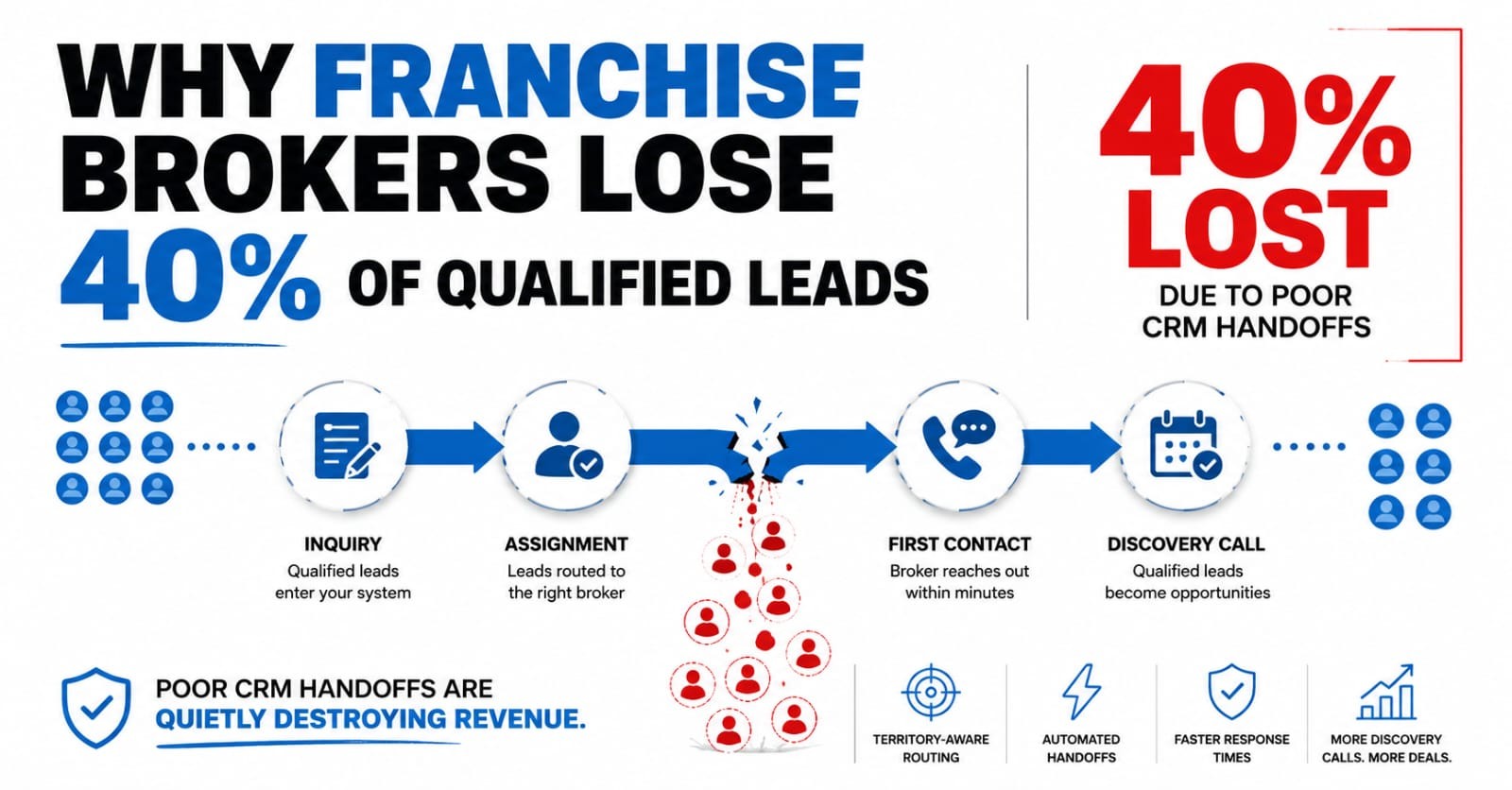
Most franchise sales organizations don't have a lead generation problem. They have a lead retention problem. The leads are already there. The systems are losing them.
At 9:47 AM on a Tuesday, a qualified franchise inquiry enters your system. Net worth: $800,000. Liquid capital: $250,000. Preferred territory: Austin, Texas. Preferred industry: home services. Timeline to decision: 90 days.
By 10:15 AM, the lead has been manually forwarded to a broker whose territory ends at the Nevada border. The shared territory spreadsheet hasn't been updated since Friday. Austin has been under contract since Wednesday. By 11:30 AM, the prospect—who submitted three inquiry forms simultaneously—receives a generic "Thanks for your interest" email with no assigned broker, no next step, no territory clarity. At 2:30 PM, they complete a discovery call with a competing brand.
Your organization will never know why that lead disappeared. It will register only as a prospect who "went cold." The CRM will show it as "attempted contact." The broker will assume another broker handled it. The marketing team will continue optimizing ad spend for a funnel that hemorrhages qualified prospects at the exact moment they express intent.
This is not an edge case. For most Franchise Sales Organizations operating in the United States, Canada, and Australia, this is the default operational outcome.
The Inquiry-to-Discovery-Call Drop-Off: Where the Money Actually Leaves
The franchise industry has invested heavily in the top of the funnel — lead generation, listing placements on Franchise Direct and Franchise Gator, paid social campaigns, referral networks, and organic search optimization consume the majority of FSO marketing budgets. The International Franchise Association (IFA) estimates that mid-cap franchisors—brands with 50 to 500 units—spend between $200 and $500 per qualified inquiry across these channels.
But the machinery that handles a lead once it arrives remains, for most FSOs, manual, slow, and structurally mismatched to the complexity of franchise sales. The result is a quiet, compounding revenue leak that never appears on a dashboard: the inquiry-to-discovery-call drop-off.
Industry operational data consistently points to a 35–45% failure rate at this precise handoff point. The lead enters the CRM. It sits unassigned, misassigned, or uncontacted past the window of buyer intent. By the time a broker initiates first contact, the prospect has moved on—often to a competitor with faster operational infrastructure.
To understand where FSOs lose leads, you have to map the stages a franchise inquiry actually moves through. Most organizations conceptualize this as a simple pipeline: lead comes in, broker follows up, deal progresses. The reality is considerably messier.
A typical franchise lead journey looks like this:
- Stage 1 — Inquiry: A prospect submits an inquiry via a listing platform, brand website, or paid ad.
- Stage 2 — Assignment: The CRM receives the lead and either queues it for manual assignment or fires an auto-assign rule.
- Stage 3 — First Contact: A broker receives the lead notification and initiates contact. — ideally within minutes, in practice within hours or days.
- Stage 4 — Qualification: The broker runs informal qualification: liquidity, background, territory interest, timeline.
- Stage 5 — Discovery Call: If qualified, the broker schedules a formal discovery call and initiates FDD issuance where appropriate.
The leak overwhelmingly occurs between Stages 2 and 3. Assignment logic fails—the lead goes to the wrong broker, or sits unassigned—and first contact is delayed past the point of recovery.
Research from the Harvard Business Review established that responding to an inbound lead within five minutes makes contact 21 times more likely than responding after 30 minutes. After two hours, the probability of meaningful contact drops by over 90%. Most FSOs are operating in that two-to-48-hour window.
This is not a motivation problem. Brokers want to close deals. It is a systems problem: the infrastructure between lead arrival and broker notification is not designed for the speed or specificity that franchise sales requires.
Why Generic CRMs Are Built for the Wrong Sales Model
Here is the uncomfortable truth that most FSO operators already sense but rarely articulate: the CRM your organization purchased was not built for franchise sales. It was built for SaaS, or e-commerce, or B2B services—linear sales processes where a lead moves through predictable stages without the regulatory, geographic, and multi-brand complexity that defines franchise development.
Generic CRMs assume a simple structure: one pipeline, one product, one owner per deal. Franchise sales breaks every one of those assumptions.
Consider what a franchise CRM actually needs to manage:
Territory logic. Each broker covers defined geographic territories. A lead from Phoenix cannot go to a broker whose territory ends at the Nevada border. Generic CRMs have no native concept of territory boundaries.
Multi-brand routing. An FSO representing ten franchise brands cannot route all leads into one undifferentiated queue. Each brand has different qualification criteria, different Franchise Disclosure Document obligations, different investment thresholds.
Qualification thresholds before FDD issuance. Under IFA guidelines in the US, and equivalent frameworks through the Canadian Franchise Association (CFA) and the Franchise Council of Australia (FCA), an FDD can only be issued to a candidate who has cleared basic qualification gates. Issuing an FDD to an unqualified prospect costs $2,000 to $5,000 in legal time. Generic CRMs have no concept of disclosure-stage gating.
Reactivation intelligence. Most franchise buyers are evaluating multiple concepts. A lead that goes cold does not always stay cold. Re-engagement sequences must be timed, personalized, and brand-specific—not a generic drip campaign.
When these requirements are not natively supported by the CRM, brokers compensate manually: maintaining spreadsheets alongside the CRM, making assignment decisions themselves, following up on gut instinct rather than system prompts. The CRM becomes a record-keeping tool rather than a sales acceleration engine. And the lead leak continues, invisible.
The Hidden Cost of Territory Mismatch
Territory mismatch deserves particular attention because it is both the most common CRM failure in franchise sales and the most silently damaging.
When a Dallas-based prospect is routed to a Chicago-based broker, one of three things happens. The broker ignores or delays the lead because it falls outside their incentivized territory. The lead is manually re-routed—a process that introduces 12 to 48 hours of delay. Or the broker contacts the lead without the local knowledge and relationship context that would make the conversation productive.
In all three cases, the lead's momentum is interrupted. And franchise leads—unlike many B2B inquiries—are emotional as well as rational. A prospective franchisee is contemplating a life decision, not a software subscription. The moment that emotional energy is not met with a competent, timely, relevant response, it dissipates.
Territory-aware routing is not a premium feature. For franchise sales, it is the operational baseline. Every lead that enters the CRM should be matched, within seconds, to the broker with territory rights, brand authorization, and current availability. When this matching is automated and instant, the first-contact problem largely solves itself.
What Automated Scoring and Territory-Aware Routing Actually Look Like
The operational mechanics of a properly configured franchise CRM are worth detailing, because the term "automation" is often used loosely in sales conversations. This is not automation in the sense of sending generic emails. It is structural decision-making that removes human latency from the highest-leverage moments in the sales process.
A franchise-specific CRM workflow functions as follows:
Lead enters with structured data. The inquiry form captures the data that actually matters for qualification: investable liquidity, geographic preference, management background, timeline. Not name and email. These fields feed directly into a qualification scoring model.
Immediate behavioral and demographic scoring. Within seconds of form submission, the lead is scored against qualification thresholds specific to each brand. A lead with $150,000 in liquid capital does not enter the same sequence as a lead with $500,000. This prevents premature FDD issuance and keeps legal costs contained.
Territory-matched assignment in real time. The CRM's territory engine matches the lead's stated geographic preference against broker territory maps. If the primary broker is at capacity or unavailable, the system escalates to a secondary assignee rather than queuing the lead.
Automated first touch within five minutes. Within five minutes of assignment, an automated first-touch fires: an SMS from the assigned broker's number and a personalized email referencing the specific brand and territory the prospect expressed interest in. This is not a generic acknowledgment—it is a brand-specific, broker-attributed communication that signals competence and responsiveness.
Broker receives a pre-qualified brief. The assigned broker receives a pre-qualified lead card in their CRM dashboard: the prospect's score, their stated liquidity range, their geographic interest, and a suggested conversation opener. The broker is not starting cold—they are entering a conversation that the system has already begun.
Escalation logic for non-responders. If no response is received within two hours, an escalation sequence triggers: a follow-up SMS, a calendar invite offer, and—if still no engagement after 24 hours—a manager notification and lead re-assignment evaluation.
The result is a system that operates at machine speed for the stages where speed matters most, and delivers human-ready intelligence for the stages where judgment matters most. Brokers spend their time on qualified conversations, not administrative routing decisions.
Nirjan International builds these franchise-specific CRM architectures for FSOs across the US, Canada, and Australia—not as off-the-shelf software installations, but as configured operational systems designed around each organization's brand portfolio, territory structure, and qualification standards.
The Revenue Math FSO Leaders Should Be Running
Your marketing ROI is determined not by your ad spend, but by your operational speed between inquiry and discovery.Consider a mid-size FSO operating in the US market with the following baseline metrics:
- 80 qualified inquiries per month
- 40% handoff failure rate (leads lost at assignment or first-contact stage)
- 15% close rate on leads that actually reach discovery call
- $35,000 average FSO commission per closed franchise deal
Under current operations: 80 leads × 60% reach discovery call = 48 conversations × 15% close rate = 7.2 closed deals per month × $35,000 = $252,000 in monthly commission.
With a properly configured franchise CRM that recovers the 40% handoff failure: 80 leads × 90% reach discovery call = 72 conversations × 15% close rate = 10.8 closed deals per month × $35,000 = $378,000 in monthly commission.
The difference is $126,000 per month—or $1.5 million per year—from the same lead volume, the same broker headcount, and the same marketing spend.
This is the business case for franchise-specific CRM infrastructure. It is not a technology investment. It is a revenue recovery operation. The leads are already there. The system is currently discarding them.
For Australian FSOs, the same logic applies in AUD with territory-specific routing aligned to state-based franchise territory maps and FCA compliance frameworks. For Canadian FSOs, CFA-context qualification gates apply. The revenue math scales proportionally regardless of geography.
What Franchise-Specific CRM Infrastructure Actually Requires
Building this system is not simply a matter of switching CRM platforms. Many FSOs make the mistake of migrating from one generic CRM to another—Salesforce to HubSpot, or HubSpot to a franchise-specific platform—without addressing the underlying configuration gaps. The platform matters less than the architecture built on top of it.
A franchise-specific CRM configuration requires:
Territory mapping infrastructure. Territory boundary maps loaded into the CRM's routing logic, with broker capacity limits and backup assignee rules.
Brand-specific qualification fields and scoring. Qualification scoring models calibrated per brand, with thresholds that gate FDD issuance and trigger appropriate nurture sequences for leads that don't yet meet criteria.
Automated first-touch workflows. First-touch sequences that are broker-attributed—appearing to come from the assigned broker, not a generic brand account—and brand-specific in content.
Escalation and override logic. Protocols that notify managers when leads exceed response time thresholds, preventing silent drop-offs from going undetected.
Disclosure-stage pipeline management. FDD issuance tracking with legal clock management, so brokers and compliance officers always know where each candidate is in the disclosure timeline.
Reactivation sequences for dormant leads. Re-engagement campaigns for leads that qualified but went dormant—timed, brand-specific, and triggered by behavioral signals rather than arbitrary calendar dates.
This is the operational build that Nirjan International deploys for franchise brokers and FSOs: a configured system that reflects the actual complexity of franchise development rather than a generic sales process dressed up with a franchise label.
The Franchise Industry's Silent Revenue Problem Has a Specific Solution
The 40% handoff failure rate is not a function of broker quality. The franchise industry attracts experienced, commercially sophisticated sales professionals. The failure is structural: the systems those professionals are working within were not designed for the regulatory complexity, territory logic, and qualification requirements that define franchise sales.
The solution is equally structural. It does not require more brokers, more leads, or higher marketing spend. It requires CRM infrastructure that matches the operational reality of franchise development—and the organizational will to build it before another year of lead leak quietly erodes revenue that the top of the funnel has already earned.
Every qualified lead that enters your pipeline and exits through a CRM handoff failure is not a lost prospect. It is a lost commission—often $20,000 to $40,000—that your marketing budget paid to generate and your systems failed to convert.
If you lead a franchise brokerage or FSO and your CRM still requires manual lead assignment, the revenue math in this article is your operational reality today. The Nirjan International CRM Setup, Management & Optimization team builds territory-aware, franchise-specific pipelines designed around your qualification workflow, brand portfolio, and disclosure obligations—not a generic sales template repurposed for franchise development.
Comments (0)
Be the first to comment.