
The Local Service Business Extinction Event: Why Google Business Profile Changes Are Wiping Out Organic Visibility
By Team Nirjan
The Local Service Business Extinction Event: Why Google Business Profile Changes Are Wiping Out Organic Visibility
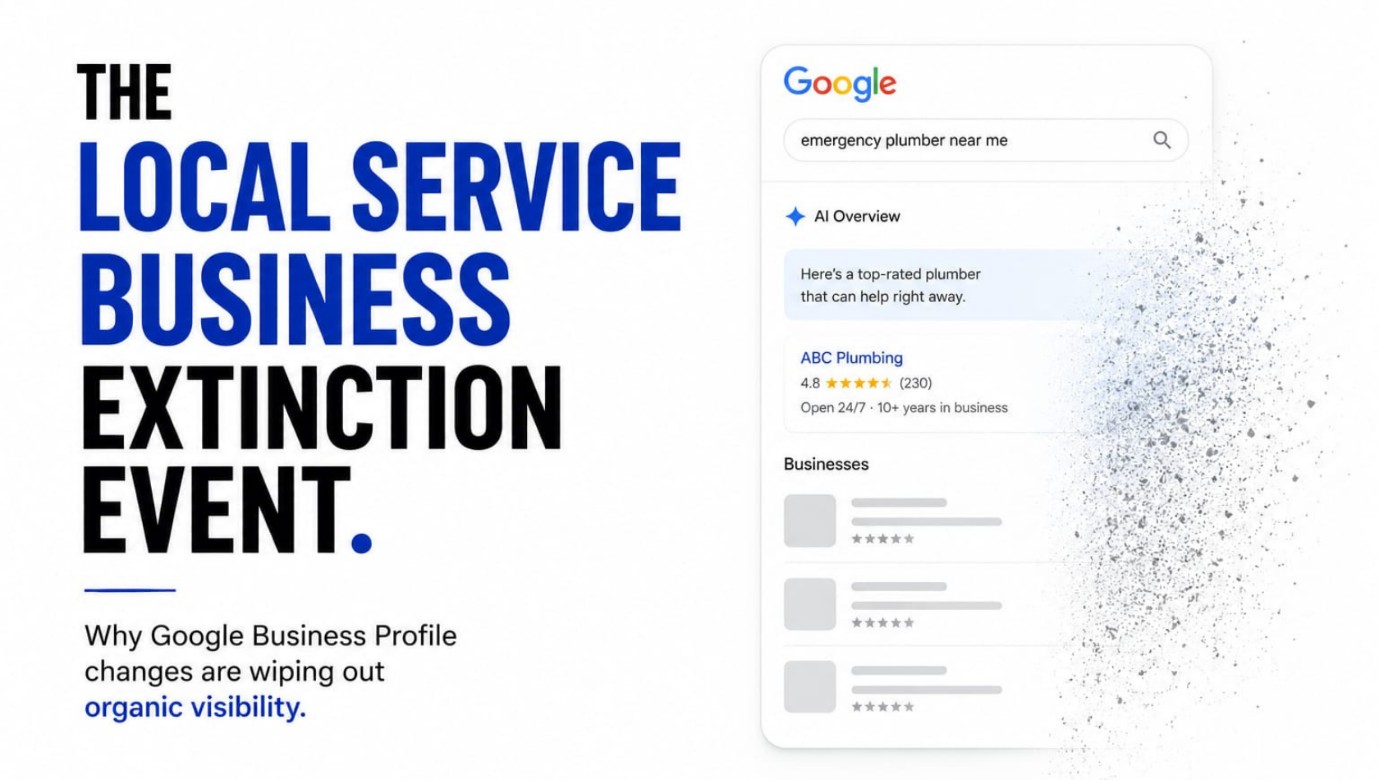
A plumbing company in Ohio hadn't changed a single thing about its Google Business Profile in eight months. Same hours, same photos, same 4.7-star rating built over three years. Then, sometime in early 2026, the phone stopped ringing the way it used to. Search "emergency plumber near me" in their service area today, and their listing simply isn't there — not buried on page two, not demoted to position seven. Gone. Replaced by an AI-generated summary naming one competitor down the road.
Nothing about that business got worse. What changed was Google. Nirjan International has been tracking this pattern across local service clients through 2026 — businesses with strong reputations and stable operations losing visibility not because of anything they did wrong, but because the infrastructure underneath Google Business Profile changed faster than most owners noticed.
The Local Pack Isn't the Local Pack Anymore
For over a decade, local search worked the same way. Type "electrician near me" or "HVAC repair," and Google served up the three-pack — three businesses, a map, star ratings, phone numbers. Owning one of those three spots was the closest thing to a guaranteed customer pipeline a local service business could earn without paying for it.
That structure is being dismantled. Since late 2025, Google has been rolling AI-generated summaries directly into local search results, and by mid-2026 industry tracking puts AI Overviews appearing in roughly 68% of local business queries. Instead of three ranked listings, many searches now return a single synthesized answer naming one or two businesses — an AI's interpretation of "the best option," assembled from Google Business Profile data, review content, and website signals, not a ranked list a user scrolls through.
The scale of the shrinkage is the part most local businesses haven't grasped yet. A comparison of the AI local pack against the legacy three-pack across the same query set found the AI version surfaces roughly 32% of the businesses the old system used to show — meaning close to two-thirds of previously visible local businesses are being cut out of the results entirely for the queries where this has rolled out. This isn't a ranking drop. It's a disappearance.
For local service businesses — the plumbers, HVAC contractors, landscapers, cleaning companies, and electricians who built their customer acquisition around "near me" search — this is closer to an extinction event than an algorithm update.
What Actually Changed Under the Hood
Google's official ranking pillars — relevance, distance, prominence — haven't been rewritten. What's changed is what "prominence" measures. It used to lean heavily on brand authority and link-style reputation signals, the kind of thing that rewarded businesses that had simply been around longer or invested in traditional SEO. In 2026, that pillar has been recalibrated to weight real-world engagement far more heavily: profile clicks, direction requests, message responses, review recency, and posting activity.
This is why a two-year-old local business with an actively managed Google Business Profile can now outrank a fifteen-year-old competitor with a stronger domain and a listing nobody has touched since 2022. Whitespark's 2026 ranking-factor research quantifies just how different the new game is: Google Business Profile signals still drive about 32% of ranking weight in the traditional local pack, but that weight drops to just 12% when a business is being evaluated for inclusion in an AI-generated answer instead. The businesses trying hardest to win the old game are, in many cases, optimizing for a scoring system that barely applies to the layer of search now deciding who gets seen.
Reviews illustrate the shift clearly. Volume used to be the whole story — more reviews, better rank. Now recency competes directly with volume. A profile with 200 reviews from 2023 is being consistently outranked by one with 80 reviews collected in the last six months. Old reviews read as evidence a business used to be busy. Recent reviews read as evidence it still is.
Location and service-area pages are facing a parallel tightening. Google's 2026 systems increasingly demote service-area pages built by swapping city names into an otherwise identical template — a shortcut thousands of local service businesses and their agencies have relied on for years. Pages now need genuinely distinct content per location: specific service details, real service-area boundaries, and context that couldn't be copy-pasted across ten different cities.
The Cost of Standing Still
Layer a second trend on top of the AI Overview shift, and the picture gets sharper: Google Local Service Ads have expanded to cover more than 70 business categories, and roughly 70% of eligible contractors now run them, up from just 28% in 2021. Paid placement now occupies an estimated 22% of tracked local search real estate — sitting above the map pack and above every organic result on the page.
Put the two trends together and the math is uncomfortable. The AI Overview layer is cutting the number of organically visible businesses by roughly two-thirds. The paid layer is simultaneously claiming a growing share of what's left above the fold. For a local service business relying on organic Google Business Profile visibility the way it worked in 2023, the addressable free audience has contracted from two directions at once inside less than eighteen months.
This isn't a story about needing a bigger marketing budget. A business can have excellent service, a strong reputation, and a clean website, and still become functionally invisible if its profile isn't feeding Google's AI systems the structured, current signals they now require to cite it. The businesses losing visibility right now aren't losing on quality. They're losing on infrastructure they don't know they need.
The Survival Framework: The Local Visibility Stack
Surviving this shift requires treating Google Business Profile as a living operational system rather than a listing that gets set up once and left alone. Three components make up what's worth thinking of as the Local Visibility Stack.
1. Review Velocity Systems
Recency now competes directly with volume as a ranking signal, which means review generation has to become continuous rather than occasional — a workflow, not a one-off campaign. The mechanics matter here. Job completion should trigger an automated review request within a couple of hours, while the service experience is still fresh — a text message outperforms email follow-ups by a significant margin on response rate. The request itself should split by sentiment before it goes public: a simple prompt asking whether the service met expectations routes happy customers straight to the Google review link, and routes anyone hesitant into a private follow-up with the business instead of a public review. That keeps friction off the public profile while still capturing the reviews that matter for ranking. Businesses with 50 or more reviews and a 4.5-star average consistently outperform lower-volume, lower-rated competitors in both organic local pack and Local Service Ads rankings, which makes review velocity one of the few levers that pays off in both channels simultaneously. When this runs as a system attached to job completion rather than something an owner remembers to do occasionally, it's the kind of infrastructure Nirjan International builds directly into a client's existing field service workflow.
2. Service-Area Page Architecture
Templated location pages are now a liability, not a convenience. A genuinely unique service-area page includes specifics that can't be swapped between cities: actual service-area boundaries, pricing or scope variations relevant to that market, and local context that signals the page was built for that location rather than generated from a spreadsheet. This is slower to build than the old find-and-replace approach, but it's what keeps a multi-location business from having its own pages compete against each other for thin-content penalties.
3. Structured Data and AI Citation Readiness
Getting cited inside an AI-generated local answer depends on Google's systems being able to extract clear, current, structured information from a profile — accurate categories, complete service lists, specific descriptions instead of vague ones, and content updated within the last six months. A profile that's technically complete but stale reads to Google's AI the same way an empty one does: not enough to cite confidently.
What Implementation Actually Looks Like
-
Audit review recency, not just review count. If the last 90 days show fewer reviews than the 90 days before that, the trend line is working against the business regardless of the total.
-
Rebuild templated location pages one at a time, starting with the highest-revenue service areas, adding location-specific service detail and removing boilerplate.
-
Complete every field in the Google Business Profile — categories, services, attributes, business description — with specific, accurate language rather than generic keyword stuffing, which is now triggering suspensions in competitive categories.
-
Track response time to messages and calls. Response speed now factors into both organic and Local Service Ads ranking, meaning a slow front desk can undo an otherwise strong profile.
-
Post to Google Business Profile on a fixed cadence. Regular posting signals an actively managed, trustworthy profile — a signal that carries more weight under the new prominence model than it did two years ago.
Beyond Google: Diversifying the Discovery Layer
The businesses navigating this best aren't relying on Google Business Profile alone. UK service businesses are leaning on Checkatrade and TrustATrader as parallel discovery channels; Australian businesses are doing the same with hipages and OneFlare. None of these replace a strong Google presence, but they reduce the risk of a single platform's algorithm change deciding a business's entire lead flow — which is precisely the position most local service businesses found themselves in when this shift hit.
Where This Leaves Local Service Businesses
The uncomfortable truth underneath all of this: most local service businesses are still optimizing for a version of local search that no longer determines whether they get found. They're chasing three-pack rankings while the real competition has moved into an AI synthesis layer with a different scoring system, a much smaller pool of visible businesses, and almost no tolerance for a neglected profile. Treating Google Business Profile as something to set up once and forget isn't a minor inefficiency anymore. It's the single largest visibility risk most local service businesses carry today — larger than an outdated website, larger than a weak ad budget.
This is also exactly the kind of shift that's hard to manage manually and easy to fall behind on quietly, because the drop-off doesn't always look like a crisis until the phone stops ringing. Building review velocity into a repeatable system, rebuilding service-area pages with real local specificity, and keeping profile data current enough for Google's AI to cite confidently isn't a one-time project — it's ongoing operational infrastructure.
This is the gap Nirjan International's SMO & SEO team steps into. Not another marketing checklist. Automated review workflows, service-area page frameworks, and structured data management that keep a local business visible no matter how Google restructures the page.
If you run a local service business and you're not sure whether you're still visible in the searches that used to bring you customers, the Nirjan International SMO & SEO + All Types of Content Branding team builds and maintains exactly this kind of infrastructure. Explore how we design visibility systems for your operational reality — before the next algorithm shift makes the answer worse.
Comments (0)
Be the first to comment.