
The Coaching Business Model Is Breaking: Why $5K–$15K Courses Are Dying and What Replaces Them
By Team Nirjan
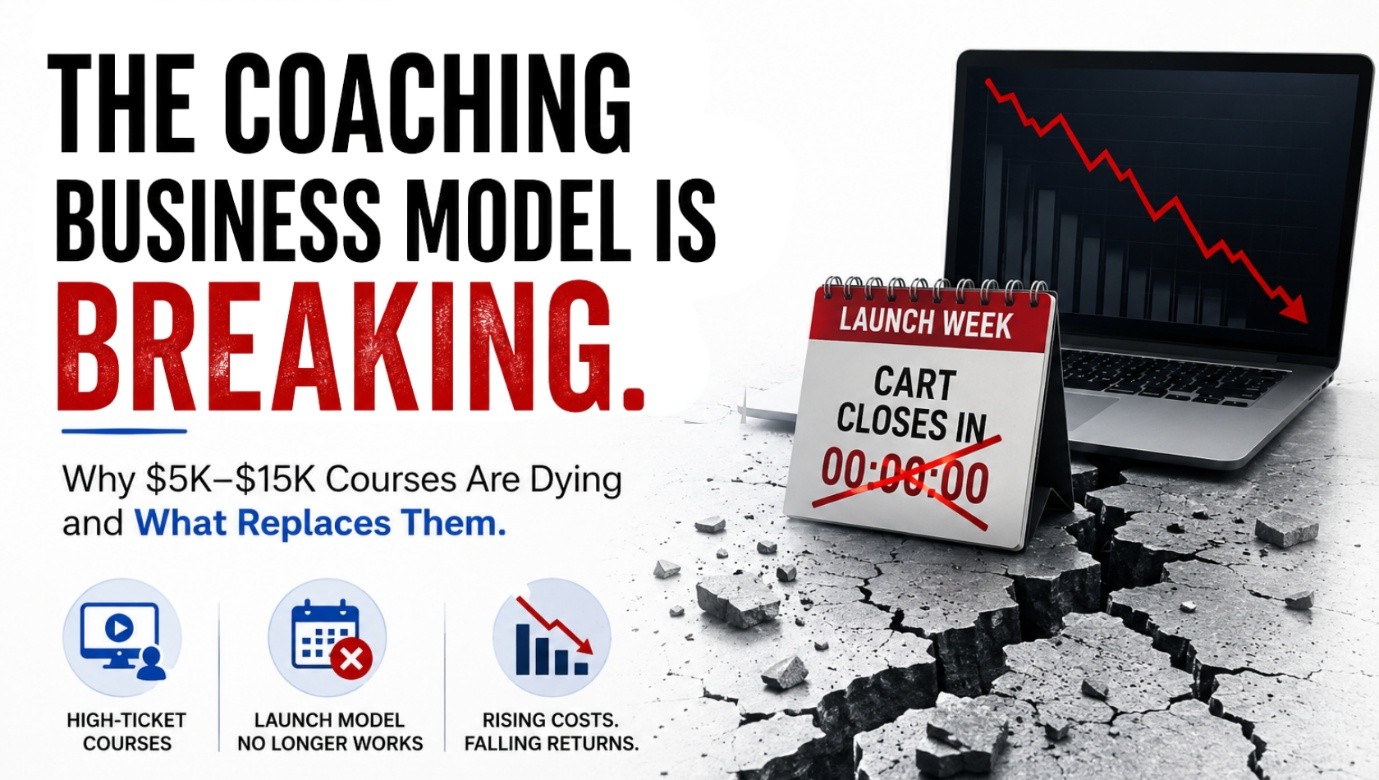
The Coaching Business Model Is Breaking: Why $5K–$15K Courses Are Dying and What Replaces Them
If your coaching business still depends on two live launches per year to hit revenue targets, you are not running a business — you are running a seasonal event company. And the season is ending.
The global coaching industry is expanding. Online delivery dominates growth. Corporate coaching spend is rising. Executive coaching retains premium pricing. Yet a specific and very common coaching operation — the $5K to $15K signature course, sold through a webinar funnel and a five-day cart-open window — is becoming structurally unprofitable for a growing number of operators. Both realities are true simultaneously. Understanding why requires looking past the product and into the economics underneath it.
This isn't a eulogy for courses. Courses still work. What has failed is the acquisition and fulfillment infrastructure required to sell them profitably at scale — infrastructure built for a digital advertising environment that no longer exists. Coaches who miss this distinction will keep refining their pitch decks, keep blaming "ad fatigue," and keep wondering why a funnel that converted beautifully in 2021 barely breaks even in 2026.
The Launch Model Was Built for a Market That No Longer Exists
The classic launch sequence — free webinar, urgency-driven cart open, five-to-seven day countdown, affiliate partners pushing the same offer to overlapping audiences — was never really a coaching methodology. It was a paid traffic arbitrage strategy. It worked because cold traffic was cheap, tracking was precise, and a coach could reliably predict that $X in ad spend produced $Y in webinar registrations, which produced $Z in cart-open sales.
That predictability is gone. And it didn't disappear because coaches got worse at marketing. It disappeared because the infrastructure underneath paid acquisition changed in ways most coaches never adjusted for.
Three structural forces drove this shift — and none of them are cyclical.
Force 1: Ad Cost Inflation and Broken Tracking
Apple's App Tracking Transparency framework limited how precisely platforms like Meta could follow a user from ad click to purchase. Without that precision, ad platforms compensate with broader, less efficient targeting — and the cost reflects it. Industry observers and operators have documented CAC inflation of approximately 300% since 2022 for cold-traffic coaching funnels, a figure that aligns directionally with broader benchmarking showing blended digital acquisition costs rising significantly across industries in the same period.
For coaching specifically, US-market benchmarks place the cost of acquiring a $5K client at $800–$2,500 in paid acquisition spend — a range that has widened considerably as platform costs climbed. A funnel that assumed $8–$12 leads in 2021 is now running on a fundamentally different cost base, while the back-end offer price hasn't moved with it.
For UK-based coaches, pressure is compounded by VAT implications — digital courses are subject to 20% VAT, which affects both pricing architecture and effective take-home on each sale, making accurate CAC-to-LTV modeling more critical than it was when margins were wider. In Australia, the post-pandemic surge in online coaching created intense market saturation — particularly in the business and executive coaching categories — making the crowded Sydney and Melbourne markets especially difficult for new entrants running launch-model funnels. In Canada, dynamics closely mirror the US: high ad costs, overlapping audiences, and a buyer pool that has become progressively more skeptical of urgency-driven offers.
Force 2: Attention Fragmentation
The launch model requires dense, concentrated audience attention to work. Attention is now diffuse. The same audience that once converted on a 60-minute live webinar now scrolls past it — not because the content is worse, but because the competition for that same attention window has multiplied across platforms. Email open rates in coaching niches have declined year over year. Facebook Group engagement has thinned. The five-day launch window assumes an audience paying close attention for five consecutive days, and that assumption is increasingly difficult to satisfy.
The structural result is that launch mechanics that once felt like leverage — urgency, scarcity, countdown timers — now feel like pressure, and buyers who recognize the pattern respond with skepticism rather than action.
Force 3: Buyer Skepticism
The market has seen the scarcity countdown before. It has seen the "spots filling fast" messaging recycled across hundreds of coaches selling structurally identical offers in identical webinar formats. Buyers have also become more credential-conscious: a market that once converted on charisma and testimonials now asks harder questions about methodology, track record, and measurable outcomes before committing to a $5K–$15K purchase.
The coaches who built audiences on authority and trust — through consistent long-form content, genuine case study depth, and transparent process documentation — are holding conversion rates. The ones who relied on funnel mechanics and manufactured urgency are watching those numbers fall. Trust, not urgency, has become the actual conversion lever, and a model built entirely on urgency has no structural answer for that shift.
The Uncomfortable Truth: It's Not the Product, It's the Infrastructure
Here is the diagnosis most coaches resist: the launch model isn't failing because information is free or because AI threatens expertise. It's failing because the operational infrastructure behind it never evolved past 2020 assumptions while costs, attention, and buyer skepticism moved on without it.
A coach selling a $7K signature program off a five-day cart-open window is running the same playbook as a coach who launched successfully in 2021 — except every input cost has changed. And the coach still has zero automated nurture sequence, zero behavioral segmentation of leads by readiness to buy, and zero recurring revenue layer to soften the brutal feast-or-famine cycle of launching, filling a cohort, going quiet, and launching again.
The diagnosis is operational, not creative. It is the same structural gap Nirjan International addresses across its coaching and online education client base: the businesses that survive a cost-of-acquisition shock are the ones that built systems to extract more value per lead and per client — not the ones that kept running the same funnel and hoped the numbers would recover.
What Replaces the Launch Model: Three Structural Shifts
The alternative to the high-CAC, low-retention launch model is a layered shift across pricing, delivery, and fulfillment.
Outcome-Based Pricing: Anchoring Value to Results
The first shift is in what's being sold. Instead of a fixed curriculum at a fixed price, outcome-based pricing ties the offer — and its perceived value — to the transformation delivered. This isn't a philosophical repositioning; it's an economic one. An outcome-anchored offer is structurally harder to refund and easier to renew, because the client's decision to continue is tied to whether the result is being achieved, not to whether they've consumed the content.
A coach who moves from a $7K one-time program to a $400/month outcome-based retainer doesn't need to close a new cold-traffic client every month — they need to retain existing clients, which is a fundamentally cheaper operational problem than acquisition. The margin pressure from rising CAC is partially offset by extending client lifetime value, and revenue becomes predictable rather than cyclical.
Micro-Coaching Subscriptions: Lower Commitment, Higher Retention
The second shift is in delivery format. Micro-coaching replaces the long-form, multi-week program with short, sharply focused sessions addressing one specific challenge at a time. Engagement data consistently shows that shorter, more frequent touchpoints outperform long-form programs on the metric that matters most for recurring revenue: client retention past the 90-day mark.
The subscription model built around micro-coaching also changes the acquisition math. A $197–$397/month subscription with strong retention can generate higher lifetime value than a $5K one-time program, without requiring a cold-traffic launch to fund each new cohort. The cost of keeping a subscriber is a fraction of the cost of acquiring a new client from paid ads.
AI-Assisted Delivery: Scaling Fulfillment Without Scaling Founder Hours
The third shift is in how coaching is delivered at the operational layer. AI-assisted delivery doesn't replace the coach — it handles everything around the coaching that doesn't require the coach's personal judgment: automated check-ins between sessions, progress tracking, intake and qualification workflows, asynchronous accountability prompts, and content delivery sequenced to where a client actually is in their program rather than a fixed weekly schedule.
This matters because it directly addresses the ceiling baked into the launch model. A coach personally delivering every touchpoint for every client has a hard limit on how many clients they can support well. A coach using AI-assisted check-ins, automated progress tracking, and behaviorally-triggered nurture sequences can serve meaningfully more clients without proportionally increasing their own hours — the operational difference between a coaching practice and a coaching business.
The critical distinction is what AI handles versus what the coach handles. Scheduling, progress data, accountability pings, content sequencing — these belong to the operational layer. The actual coaching relationship — diagnosis, challenge, reframe, accountability — remains human.
The Operational Infrastructure Behind the Shift
Translating these three shifts into a functioning business requires operational infrastructure that most coaches currently don't have.
Automated nurture sequences, behaviorally segmented. Instead of a single blast to a cold email list ahead of each launch, an always-on nurture sequence moves leads through a decision process over weeks or months — segmented by engagement behavior, not just opt-in date. A lead who watches a full training video and opens every follow-up email is a fundamentally different prospect than one who opted in and went silent. Treating them identically wastes ad spend and undermines conversion.
CRM-backed behavioral scoring. Behavioral scoring assigns readiness signals to leads based on what they actually do, not what they claim to be interested in. This allows a small team — or a solo founder — to concentrate follow-up effort on leads showing genuine buying signals rather than manually working through an undifferentiated list.
Retention tracking as a primary metric. A launch-model business obsesses over cart-open conversion rate. A recurring-revenue model lives or dies on month-three and month-six retention. These are different businesses with different operational dashboards. The recurring-revenue coach needs to know which clients are engaging regularly versus going silent, which milestone correlates with the decision to renew, and which client profiles churn fastest. Without CRM infrastructure that tracks engagement over time and surfaces these patterns, retention decisions are made on gut instinct — which produces the same result as running a launch without tracking ad spend by creative. Without data, there is no lever to pull.
AI-assisted fulfillment workflows. Automated check-ins, progress dashboards, and sequenced content delivery require connected infrastructure — typically a CRM with automation capabilities, integrated with the delivery platform — that most coaches either haven't built or have assembled from disconnected tools that don't communicate with each other.
This is precisely the gap that Nirjan International's automation and AI workflow integration practice is built to close for coaching businesses: not a software recommendation, but a connected operational system — behavioral lead scoring integrated into the nurture sequence, automated fulfillment workflows that reduce hands-on delivery load, and a CRM layer that surfaces clients approaching churn before they cancel rather than after. The coaches making this transition successfully are doing it with infrastructure, not willpower.
The Transition Window Is Now, Not Later
The coaches waiting for acquisition costs to come back down are waiting for something structural trends don't support. Privacy-driven signal loss is regulatory, not cyclical. Platform competition is increasing, not decreasing. Buyer skepticism compounds with every coach who enters the market with a recycled launch sequence and a countdown timer.
The launch model isn't dead. It's no longer sufficient as a complete business architecture. Used as one channel within a broader system — where cold-traffic acquisition feeds an automated nurture sequence, which converts leads into subscription clients, who are retained through AI-assisted fulfillment and tracked through a CRM that generates actual retention data — it still has a role. The problem is that most coaches are running it as their entire business, with nothing underneath to catch the leads it doesn't convert or retain the clients it does.
The coaching businesses that will look structurally sound in 2027 are building that infrastructure now — before the next launch underperforms and forces the pivot under pressure. Outcome-based pricing, micro-coaching subscriptions, and AI-assisted delivery are not experimental alternatives to the launch model. They are the operational layer the launch model was always missing. The coaches who build that layer proactively — while the launch still has enough margin to fund the transition — will be in a structurally different position than the ones who wait for a bad quarter to force the conversation.
The window for a managed transition is open. It won't stay open indefinitely as platform costs continue to rise and the trust gap between coaches and cold-traffic buyers continues to widen.
If you're running a coaching program built entirely around the next cart-open date, the Nirjan International automation and AI integration team builds the nurture sequences, behavioral scoring systems, retention tracking infrastructure, and AI-assisted fulfillment workflows that let coaches shift toward recurring, outcome-based models — without rebuilding the entire business from scratch while a launch is already running.
Comments (0)
Be the first to comment.